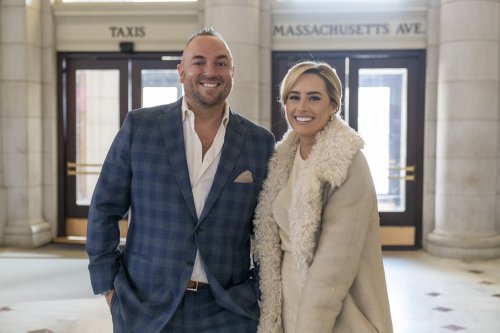


BostonMan Magazine x Jacqui Heinrich – official COVER SHOOT video

A Sunday Briefing on the Life & Career of Jacqui Heinrich
BY THE TIME most people are settling into their first cup of coffee each morning Jacqui Heinrich has already lived a full day.
On a recent foreign trip, she spent daylight hours tracking the president’s every move in Tokyo, then stayed up through the local night to appear live on East Coast broadcasts. She slept in two-hour bursts on top of the bed so she wouldn’t fall too deeply asleep and miss a hit. Everything she ate came out of a wrapper. The schedule was brutal, the stakes enormous, and the glamour—at least in that moment—nonexistent.
And that’s exactly how she likes it.
Heinrich, now one of the most visible political journalists in America and the incoming president of the White House Correspondents’ Association for 2027–2028, is in the prime of a career built on rigor, discipline, and a very particular kind of New England steel.
Her latest venture, The Sunday Briefing on Fox News, a one-hour show she rotates anchoring with Peter Doocy, has sky-rocketed to the top of the ratings charts across all demos -including a triple-digit stranglehold lead with the coveted 25-54 audience- since debuting in September.
To viewers, she’s the composed senior correspondent who moves effortlessly from the North Lawn to the briefing room to her own one-hour political analysis show. Inside the building, she’s also the colleague who walks through the White House gate already late for something that just appeared on her schedule five minutes ago.
“It’s so hard,” she admits of the job. “There is no room for failure or error there.” And yet, that high-wire act is exactly what has made her one of the most trusted—and closely watched—voices in American political journalism, regardless of which political affiliation is viewing.
If you want to understand where that mindset comes from, you don’t start in Washington. You start in New England.

New England in Her DNA
Heinrich was born just outside Boston, and lived in Lincoln and Gloucester, before her parents -both from Lexington- moved to New Hampshire and Maine. It’s safe to say New England runs through her veins. “We were always in Massachusetts,” she says. Even now, despite a job that keeps her chained to the most powerful address in America, she still flies home for siblings’ birthdays and family events whenever she can. If she could add one piece of infrastructure to the world, it wouldn’t be a new highway, but a teleporter between D.C. and New England.
Growing up in a place where your hair freezes into icicles at the bus stop does something to your personality. Heinrich laughs when she calls it “the part of you that just says the thing.” It’s not rudeness—it’s economy. New Englanders, she believes, are wired to get to the point.
That instinct shows up at work more than anywhere else. Not long ago, during a pre-briefing huddle with press aides and reporters milling around the West Wing, a colleague joked about “saving the toughest question for last.” Heinrich didn’t wait for the laughter to die down. She simply said, “If it needs to be asked, I’m asking it in the room. That’s the job.” It wasn’t bravado—it was matter-of-fact. She had already done the calls, secured the context, checked the sourcing. By the time she takes her seat in the briefing room, she isn’t performing. She’s there to get answers. Staffers know it. Reporters know it. And because her questions are grounded in actual reporting—not theatrics—they land differently. The temperature in the room shifts. The conversation moves.
To some, that kind of bluntness might feel abrasive. To Heinrich, it’s just being honest about what everyone is already thinking. That same candor—tempered by discipline and fairness—is the spine of her reporting.
What’s striking is that she never planned to be on television at all.

From Statecraft to Storytelling
As a student, Heinrich was drawn first to international affairs and the architecture of power: how people organize themselves, create rules, enforce them, and then build narratives to justify it all. She imagined herself at the State Department, not the White House press workspace.
“I always just was interested in history and how that’s playing out on a global stage,” she explains. She devoured political science but quickly grew impatient with reading about life in books instead of talking to the people living it.
A summer program at Duke gave her a crucial early insight. The campus, with its quads and sports games and neat little bubble, felt like a “manufactured society.” It might be perfect for someone else, but she knew she’d spend all four years wondering when she could leave and start doing real work.
Instead, she chose George Washington University in Washington, D.C. Her classes took place in buildings like the World Bank; her professors were adjuncts who spent their days in the State Department or other agencies. It felt, finally, like the real world.
The final nudge toward journalism came almost by accident. While interning on Capitol Hill, she became fascinated by how a specific story—about a bridge—migrated from the halls of Congress to cable news. Through a mutual connection, she tracked down the producer for MSNBC’s chief Washington correspondent at the time, Norah O’Donnell, and asked: How do you do that?
The answer was an internship.
Her job was deceptively simple: summarize all the news of the day into a digest for O’Donnell each morning. The exercise sharpened her news judgment, speed and writing, and O’Donnell quickly noticed. She told Heinrich she should learn the on-camera side and walked her down the hall to WRC, the NBC affiliate. There, Heinrich befriended chief photographer Ron Leidelmeyer, who taught her to shoot and edit. She put together a reel, mailed it all over the country, and landed her first job sight unseen in Colorado Springs for $18,000 a year.
Trial by Fire Out West
It was a one-man-band life: shoot, write, edit, go live. It was also trial by fire—literally. Her first summer on the job, Colorado burned. The Waldo Canyon Fire and the Black Forest Fire consumed hundreds of homes. She watched farmers turn their horses loose so they wouldn’t be trapped by the flames. She watched state government improvise evacuations and emergency plans in real time.
“It was the most formative experience that I had had,” she says. It taught her what it looks like when policy, weather and human beings collide—and it showed her something else that still animates her work: in disaster, people help each other.
“There are just these tragic scenes,” she recalls, “but you see people really come to the aid of their neighbors.” That theme would follow her from Colorado to Las Vegas to Boston, long after she left local news.
From Colorado she moved to Las Vegas as a reporter and then anchor. From Vegas she came home to Boston as a three-contract local reporter at Boston 25, living in Cambridge and rediscovering her hometown as an adult with a press badge.
New England embraced her. In 2017 she was named General Assignment Reporter of the Year, winning an Emmy for her body of work, including coverage of a deadly trench collapse in South Boston and the kind of blizzard live shots that only a New Englander could fully appreciate. During one storm on the Cape, her satellite truck mast froze in the upright position, trapping her crew on site. A nearby family ran an extension cord outside, plugged in a hair dryer, tried to thaw the mast, and brought hot chocolate through the night.
“We might not be nice,” she jokes of New Englanders, “but we’re definitely kind.” Honesty on the surface; deep kindness underneath.

Vegas, Tragedy, and a Door to Fox
Jacqui’s Vegas chapter followed her back to Boston in an unexpected way.
On the night of the mass shooting at the Route 91 Harvest festival, Heinrich was already at Boston 25. But because she had so many sources in Las Vegas—friends on the Strip, casino workers, law enforcement contacts—the station sent her west. Leaning on those relationships, she secured the first photos from inside the gunman’s hotel room, images that showed the weapons and bump stock that would ignite a national policy debate.
While many Americans learned her name that week, one particular anchor at Fox News had already taken note. Shepard Smith put her on air for a segment from Vegas. When her reel landed in New York later, that appearance was part of the conversation.
A few months later, Heinrich made the leap: from Boston local news to Fox News Channel as a New York-based general assignment reporter.
If Colorado taught her about fire, and Vegas taught her about horror and resilience, New York and Washington taught her about politics at scale.

Campaigns, a Pandemic, and a Cat in a Hotel
In 2019, she was on the road covering the Democratic primary field when the World Health Organization declared a pandemic. She remembers being in Ohio, preparing for dueling rallies by Biden and Sanders, only to watch both events collapse into cancellation. She and her producer retreated to their hotel, wondering, “What do we do now?”
What followed was one of the strangest stretches of modern campaign reporting. For roughly three months, she covered a presidential race from her living room, broadcasting live from a phone app while Fox shipped equipment to reporters’ homes.
When travel resumed, she found herself more or less living at the Westin in Wilmington, Delaware, as Joe Biden transitioned from candidate to president-elect. Thanksgiving, Christmas, New Year’s, her birthday—they all happened at that hotel, where she eventually brought her cat to live with her in the room.
From Wilmington she came to D.C., briefly covering Capitol Hill before moving to the White House beat full-time in 2021. Within a few years, she would be one of the most visible questioners in the briefing room and a two-term board member of the White House Correspondents’ Association, representing more than 900 members across television, print, radio, wires and photo.
The Same Voice Under Two Presidents
If there is a single thread running through her White House work, it’s that she refuses to alter her core approach based on who holds power.
“I am the same no matter who I’m talking to,” she says. She is not a bomb-thrower, not a gotcha-question person, not a performer. Her questions are the ones she genuinely wants answered, and the ones she believes viewers need answered to navigate their own lives.
That consistency has won her critics from both sides—viewers who want their favorite networks to punish enemies and praise allies—and it has earned her something rarer: respect from colleagues across the press corps.
When it comes to workflow, the differences she sees between administrations are less ideological than operational. Under Biden, access was tightly controlled. She recalls months of denied or ignored meeting requests with the press secretary and a communications structure that felt like “holding this whole thing together with scotch tape”—so many factions within the Democratic Party believing they owned a piece of the presidency that official statements sometimes tried to please everyone and ended up pleasing no one. To understand what was really happening, she had to work sources relentlessly outside the building, meeting people who didn’t necessarily want to be seen talking to a Fox reporter.
Under Trump, the environment is the opposite: more chaotic, more forceful, but also more direct. You can often “ask the question of whomever and get the answer in pretty short order,” she says. The challenge is drinking from the firehose—processing and contextualizing a torrent of information and messaging in real time.
That dual experience—working both Democratic and Republican administrations at the highest level—is precisely what she wants career-wise. “It’s really important to me that I get to cover a Democrat and a Republican,” she says. “For career development sake, compare, contrast.” She knows she won’t be “a slave to the calendar” forever, but for now, she is all-in.

Building a Sunday Habit
Her most visible new project is “Sunday Morning Briefing,” the one-hour show she co-anchors in rotation with colleague Peter Doocy. Launched in September, the show gives Heinrich something she rarely had in daily news hits: time.
Covering the White House, a day’s worth of complex maneuvering might be compressed into a 90-second package. An hour on Sunday is a different universe. It allows her to book big guests—she has already landed interviews at the very center of world events—dig into the “why this matters” behind policies and polls, and walk viewers through the moving parts of legislation or geopolitical crises.
Her standard is not to push viewers toward a particular feeling, but to make sure they have enough information to decide for themselves. That discipline, she believes, comes in part from growing up with parents who sit on different sides of the political spectrum, and from years spent making sense of those arguments around the dinner table. Her job, as she sees it, is to understand why people pursue a certain direction—and then give equal attention and detail to the opposing argument.
“That’s the work of being fair,” she says. “Telling the story fully in context, with nuance, with detail… not driving an agenda.”
She and Doocy watch each other’s shows and compare notes. Over time, she hopes viewers will feel like they’re squeezed into the tiny White House booth alongside them, hearing the same back-and-forth they have off-air in a workspace barely bigger than a closet.

Inside the WHCA and Behind the Scenes
Behind the camera, she’s doing similar work as a board member of the White House Correspondents’ Association and its future president. The role is unglamorous and demanding: negotiating access to historic moments, advocating for pool coverage, hashing out logistics, and even helping line up visas and cable runs for foreign trips.
“A lot of it is diplomacy,” she explains. You have to explain to an administration why they should want to use the press pool that already exists to get their message out—and why letting independent journalists ask questions ultimately strengthens their legitimacy. The payoff is access not for herself, but for the hundreds of reporters and outlets she represents.
It’s volunteer work that consumes huge chunks of her schedule on top of her reporting and anchoring. But it reinforces a basic truth about her: she is most comfortable fully immersed in the work, whether that’s pushing for a camera position on a foreign trip or squeezing a little more detail out of a White House readout.
Love, Congress, and a Cat Casket
For someone so fiercely private about her personal life, she’s surprisingly open when asked about her fiancé, Congressman Brian Fitzpatrick. Their story sounds almost like a West Wing subplot.
She first met him in a professional context while covering the Hill—a roundtable here, a legislative dinner there. They never discussed their personal lives. She compartmentalized. He noticed.
Months later, after she had moved to the White House beat, Fitzpatrick asked if she’d be his guest at the Kennedy Center Honors. She wasn’t even sure, at first, that he was asking her on a date. She went through the proper channels with her bosses, thought over whether it might affect her career, and -with the full support of her FOX- eventually said yes. Dates followed: progressively nicer dinners, long conversations that went beyond votes and floor schedules.
She discovered a man who had spent 14 years in the FBI, who never sought office for ego, and who only ran for Congress after his brother, the district’s representative, was dying of cancer and asked him to carry on the work. He approaches his job with the same moral calculus she brings to hers. “His litmus test is, I have to be able to defend this,” she says. If he can’t, he won’t do it.
The story she tells that reveals his character isn’t glamorous. It involves a cat casket.
Heinrich’s cat of 16 years was dying of cancer. The vet offered options; the prognosis was grim. Heinrich couldn’t bring herself to think about what would happen afterward—burial, cremation, anything. Fitzpatrick could. Quietly, he called her father and asked whether they could bury the cat at the family home on Lake Winnipesaukee. Then, anticipating every possible scenario, he ordered a small pet casket and had it shipped—conspicuously labeled—through the halls of Congress to his chief of staff’s office.
In the end, Heinrich chose cremation. Fitzpatrick called the company and tried to return the unused casket. They weren’t sure anyone had ever asked before.
It’s a darkly funny story, but it also tells you almost everything you need to know about both of them: her reluctance to center herself in the narrative, his instinct to shoulder the hard logistics for someone he loves, and the way both of them are constantly thinking three steps ahead, whether in legislating or live shots.
Their life together is, unsurprisingly, scheduled to the minute. They both live by their calendars—his, dictated by the congressional schedule; hers, by the White House and breaking news. Vacations can shrink overnight; a planned ten-day trip to France became a whirlwind 72 hours when he had to fly back for a vote on a “big, beautiful bill.” They both understand that this phase of their lives—a phase defined by duty, public service and relentless work—is finite. For now, they manage it. Later, they’ll have time to exhale.

Sewer Rat, Oscars, and the Runway Ball
Somewhere amid all this, Heinrich still finds room for fashion—not as a frivolous indulgence, but as another extension of her insistence on individuality. She has worn couture borrowed from her mother to high-profile events, only to see it land on a “worst dressed” list. She laughs. She still loves the dress.
Another year, she bought a gown in a Koreatown wholesaler in New York with no brand name and no fitting room, trying it on under a stairwell and paying cash.
“I never feel like myself if I feel like a carbon copy,” she says. On camera, she’s fully made up. Off camera, she jokes that her only two modes are “sewer rat or Oscars,” nothing in between. It’s all or nothing—much like the rest of her life.
That’s part of what makes her presence at Boston’s Runway Ball this year so fitting. When she walks into that majestic Grand Ballroom at The Hilton Boston Park Plaza, she won’t just be another high-profile guest in a great dress. She’ll be a reminder of what happens when New England bluntness meets national ambition; when a kid who grew up running between Massachusetts, Maine and Lake Winnipesaukee decides that reading about power isn’t enough, she wants to interrogate it in real time.

It’s easy, in an age of partisan shouting and performative punditry, to become cynical about political media. Heinrich is an argument against that cynicism: a reporter who sleeps on top of hotel beds so she doesn’t miss an overnight live shot, who spends her “off” hours fighting for press access, and who still lights up when she talks about a family on the Cape running a hair dryer out into a blizzard so a frozen news truck can finally stand down.

She is, unapologetically, in the middle of the road—some say, if you stand there long enough, you get hit by cars on both sides. But for now, she stands there anyway, asking the questions that matter, for the people back home whose lives are shaped by decisions made just beyond the podium in front of her.
Jacqui Heinrich may not be the last true journalist in America; unwavering in her commitment to present pure authentic information that matters. But she may very well be the leader of those of us that remain.