
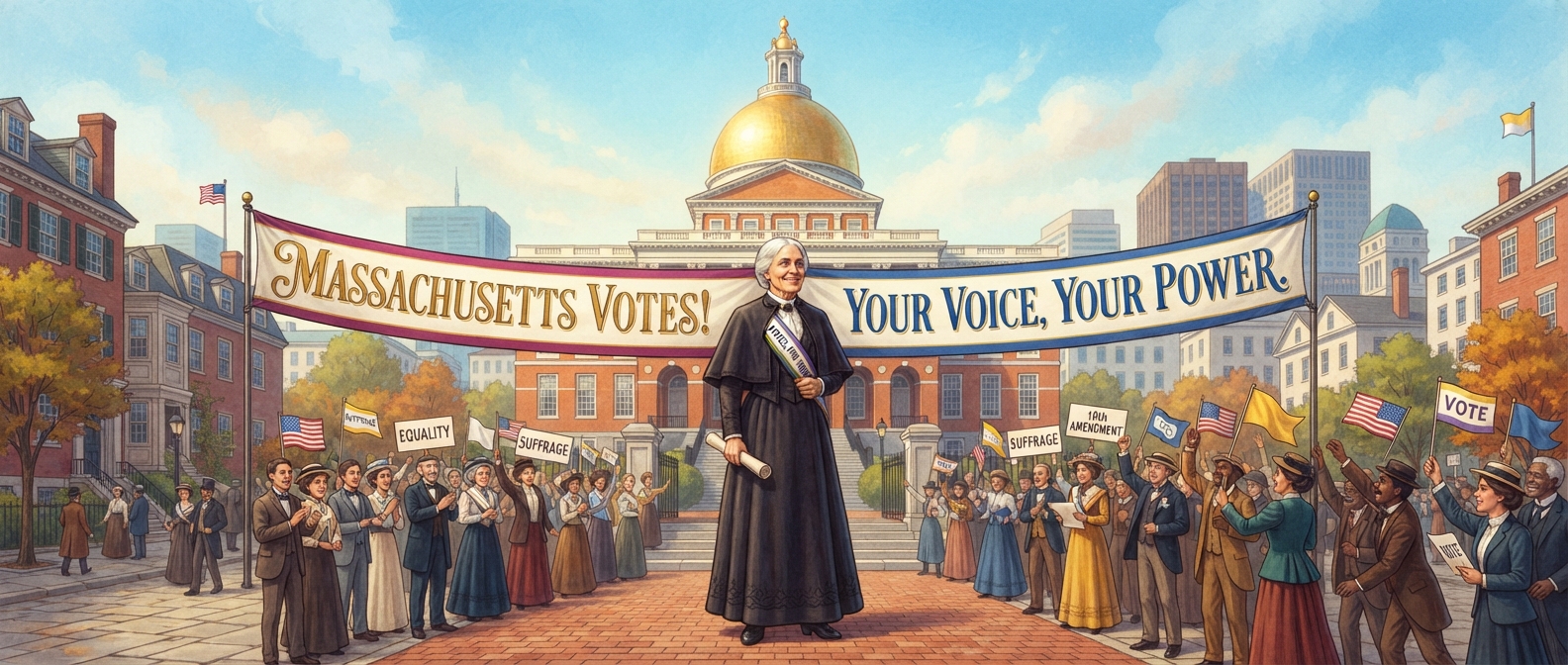

DEEP IN THE BERKSHIRES, nestled in the town of Adams, Massachusetts, stands a modest federal-style house. To a casual passerby, it is a charming piece of New England history. But to anyone who has ever cast a ballot, this house is hallowed ground. This is the birthplace of Susan B. Anthony, the woman who stared down an unjust legal system, faced arrest for the simple act of voting, and spent her entire life engineering the democracy we enjoy today.
Though her name is permanently etched into the story of Rochester, New York, where she did her foundational work and was famously tried for illegal voting, it was the soil of
Massachusetts that cultivated her revolutionary spirit. Her childhood in the Commonwealth planted the very seeds of a movement that permanently reshaped American history. Today, as we face modern elections, Anthony’s early years and lifelong crusade serve as a powerful reminder: the ballot is a hard-won right, a tool for justice, and a legacy we cannot afford to waste.
The Quaker Roots of the Berkshires
Long before she was a household name, Susan B. Anthony was a young girl living in Adams, immersed in a tight-knit Quaker community. She lived in Massachusetts until she was six years old, a brief but deeply formative window of time. The Society of Friends held beliefs that were radical for the early 19th century: they viewed men and women as spiritual equals. In Quaker meetinghouses, women spoke publicly, held leadership roles, and were encouraged to pursue rigorous educations.
In a world that legally and socially silenced women, the environment of Western Massachusetts taught a young Susan that her voice carried weight. This foundational sense of equality—born right in the shadows of Mount Greylock—became her lifelong north star.
When her family later moved, Anthony carried that Massachusetts conviction with her. Her activism quickly expanded from anti-slavery efforts and the temperance movement to the ultimate systemic battle: winning women the right to vote. She understood that without the ballot, no citizen could truly protect their own freedom, change unjust laws, or shape the moral landscape of their nation.
A Legacy Left at the Ballot Box
The defining moment of Anthony’s crusade came in November 1872. Testing the legal boundaries of the newly ratified Fourteenth Amendment, Anthony walked into a voting registry, demanded to be registered, and successfully cast a ballot in the presidential election.
The response from the government was swift: she was arrested, indicted, and put on trial by an all-male jury. The judge refused to let her testify in her own defense, directing the jury to find her guilty before a single deliberation could take place. When asked if she had anything to say before sentencing, Anthony delivered a blistering rebuke of the court, calling the proceedings a “high-handed outrage upon my citizen’s rights.” She was fined $100—a sum she proudly vowed never to pay.
Anthony did not see her arrest as a defeat; she saw it as proof of how deeply the establishment feared the power of a single vote. And she was far from alone. Across generations, countless civil rights leaders, suffragists, and everyday citizens have stood up, marched, and bled for this exact privilege: the right to have a voice in how they are governed.
The Engine of Our Democracy
Today, the path to the ballot box has been cleared by the giants who came before us. We no longer have to risk imprisonment or face societal exile just to register. Yet, the real work of keeping a democracy alive falls squarely on the shoulders of the living. Democracy is not a monument to admire; it is a muscle that must be exercised.
We see this responsibility vividly in our own backyard as the race for Governor of Massachusetts unfolds. Voters across the Commonwealth are faced with a fundamental choice between the vision of incumbent Governor Maura Healey and challenger Mike Minogue.
Whether you wish to support Maura Healey or Mike Minogue at the polls, the true civic obligation begins long before stepping into the voting booth. It is vital to take the time to look past the soundbites, get to know both candidates, understand their platforms, and decide which direction aligns with your values.
Finishing the Fight
Susan B. Anthony died in 1906, fourteen years before the 19th Amendment was finally ratified in 1920. Her famous last public words, “Failure is impossible,” were a rallying cry for persistent, active participation.
When we sit out an election, look past a local race, or allow ourselves to believe that our single vote doesn’t matter, we minimize the very fight that began in that small house in Adams.
Regardless of which candidate wins the governor’s mansion or which political party carries the day, showing up is how our democracy stays alive and thrives. As this election approaches, look west toward the Berkshires and remember where the fight began.
Honor the legacy of Susan B. Anthony and the many who marched alongside her. Check your registration, research the candidates, get out to the polls, and vote.
Your voice is your power—use it.
____

Matt Ribaudo is the Owner and Publisher of BostonMan Magazine. He can be reached directly at matt@bostonmanmagazine.com or via social media.
