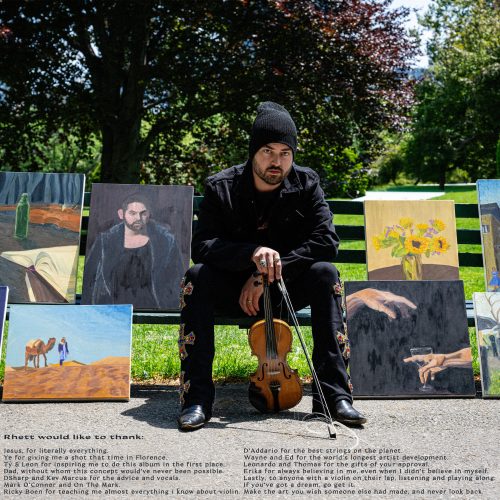

For a decade, Rhett Price was the best in the world at playing other people’s songs. Then a twelve-hour session in a Florence hotel room with Kanye West and Ty Dolla $ign convinced him he had his own to write, so he taught himself to produce beats and paint in oil, and vanished for two and a half years to prove it.
______________
_______
THE MORNING RHETT PRICE talked his way into one of the most secretive recording sessions in music, he was standing at the top of the Leaning Tower of Pisa, thumbing out a text to Ty Dolla $ign.
He wasn’t supposed to be in Italy at all. A few weeks earlier, Rhett had seen the rumor ricocheting around social media: a fan had posted a selfie with Ty in Florence and mentioned he could hear Ye working on an album in the hotel room across the hall. Nobody had announced anything. But Rhett had recorded strings for Leon Thomas a handful of times, and Leon had just signed to Ty’s Motown-affiliated imprint. That was his thread. The question was how to pull it.
Most people would have fired off a cold DM and hoped. Rhett engineered a reason to be there already. “I’m like the king of somehow getting things to land in my lap,” he told me. “I feel like I will things into my life.” So he emailed thirty or forty destination wedding planners with a single pitch: I’m trying to be in Italy on these dates. I’ll work within your budget. I’ll make it work. A planner came back with a couple getting married in Genoa in mid-September; they’d seen his videos, they loved him, he was in range. He booked the wedding. Then he messaged Ty on Instagram, offered to lay down strings for the Ye sessions, and got a reply the same day: “Ok, see u on the 17[th] gang.”
Which is how he found himself atop a medieval tower, getting a hotel address from Ty Dolla $ign. He thought he’d been brought in to play on a song or two. Kanye wasn’t even in the room, he’d just left for Venice with his wife, for what would become a very famous boat trip. Ty FaceTimed him in, aimed the phone at Rhett, and let Ye watch a few bars over the feed. Within twenty minutes the verdict came back down the line: Get him on everything. Rhett played from three in the afternoon until three in the morning. Twelve hours. Song after song after song. One of the tracks on the new album is literally called “12 Hrs in Florence.”
You Work Like Us
Somewhere around midnight, eight or nine hours deep, demo after demo, Ty stopped and asked how he was holding up. Rhett didn’t hesitate: Let’s go to the next one. Ty looked at him, looked at the engineer, and said, “Man, you work like us.”
“That’s possibly the best compliment I’ve ever gotten,” Rhett said. “And that’s not how I work because I’m in the room with Ty Dolla $ign. That’s just how I work, period.”
But the compliment isn’t what changed him. What changed him was watching. He’d walked in assuming Ye and Ty were there to write lyrics and rap. Instead he watched them play keyboards and guitars, build chords out of nothing, sweat every micro-decision on songs that might never see daylight. “They know what they’re doing,” he said. “They’re so much more into every little nuanced part of everything they put out than I realized.”
And in the middle of the most exciting night of his career, Rhett had a quietly deflating thought about his own. For the better part of a decade, the thing that had put gas on the fire was viral cover videos, his violin over somebody else’s hit. In that hotel room he finally named what a cover doesn’t let him do. “The song already exists,” he said. “The beat’s done, the melody’s done. I can’t really add much. I can’t be much of an artist.” Then the flip side, the part that sent him home with a plan: “I actually have something to offer. And to me, that’s what being an artist is. It’s not playing other people’s songs. It’s creating something from the ground up.”
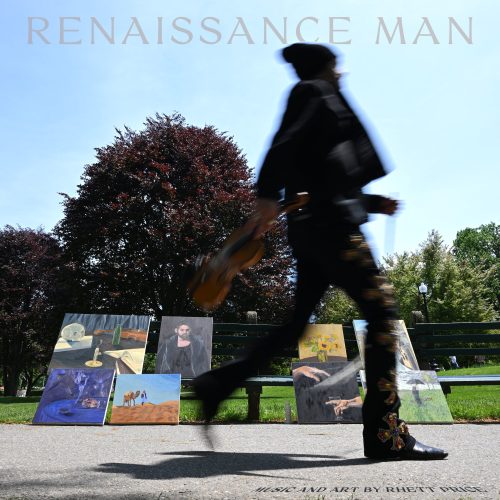
The album that resulted from that realization is called Renaissance Man. It is the first fully original body of work of his life.
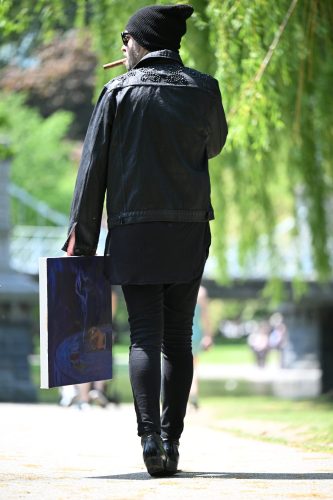
The Strings That Didn’t Survive
There’s an irony buried in the Florence story that Rhett volunteered himself, and it turns out to be the whole thesis of what he did next. For all those hours of playing, almost none of his strings survived to release. Between Rhett and another violinist friend, the two of them recorded on something like thirty songs across the two Vultures albums. When the records finally came out, exactly one had strings on it.
Take “River,” a track on the first Vultures and one of Rhett’s favorites. He’d layered strings all over it. Then, at the last minute, Kanye swapped them out for synthetic horns, a very Ye decision, Rhett allowed, and the record turned out great either way. But at the listening parties, he watched Ty pantomime playing violin on a song where the real violin had been quietly deleted and replaced with a synth. “There’s a lot of hands things can go through between the session and the release,” he said, “and a lot of decisions that get made because someone’s feeling something else in the moment.”
Sit with that image for a second, because Rhett clearly has. The thing a person actually played, erased, and replaced with the synthetic version because it was faster, or cleaner, or simply the mood of the room.That is not a small anxiety in 2026, and it’s the one he circled back to again and again: in an age when a passable beat or a slick image can be conjured out of thin air in seconds, what is the worth of a thing made slowly, badly at first, entirely by hand? His answer to that question became a two-and-a-half-year project. The swapped-out strings on “River” were the omen. Renaissance Man is the rebuttal.
One of Ours
Those of us at BostonMan have had a front-row seat to Rhett Price for a while now, which is exactly why this chapter is worth telling. We tend to get people on the ground floor and then watch them go doremarkable things, and Rhett has been one of ours for years. He wrote for these pages — his column, The Enthusiast, ran in his own unmistakable voice, all confetti and 4:30 a.m. Logan departures and the relentless certainty of a man who books his own miracles. He’s the performer who left a Legacy Club room at the UMass Club genuinely in awe, who greeted the crowd at Big Night Live’s Punch4Parkinsons fight card with a violin instead of a bell, who once turned a Ben & Jerry’s collaboration into a benefit for the Pine Street Inn, a full-circle gesture from a man who, not many years before, had been sleeping on park benches himself.
That’s the part of the story most people already know: the Texas kid with the fiddle and the saxophone, the Berklee education, the 2013 busking video of Taylor Swift’s “I Knew You Were Trouble” shot at South Station that the Boston Globe turned into a headline: “homeless violinist to YouTube sensation.” Thirty million views. Stages shared with T-Pain, Machine Gun Kelly, Young Thug, the Dropkick Murphys. A wildly successful career, built almost entirely on the genius of interpreting other people’s songs. We’ve covered all of it. This is the first time we get to introduce a different Rhett Price, not the world’s best hired gun, but an author.
Sixty Hands and One Eye
Here is the sentence that should stop you: he had never held a paintbrush in his life.
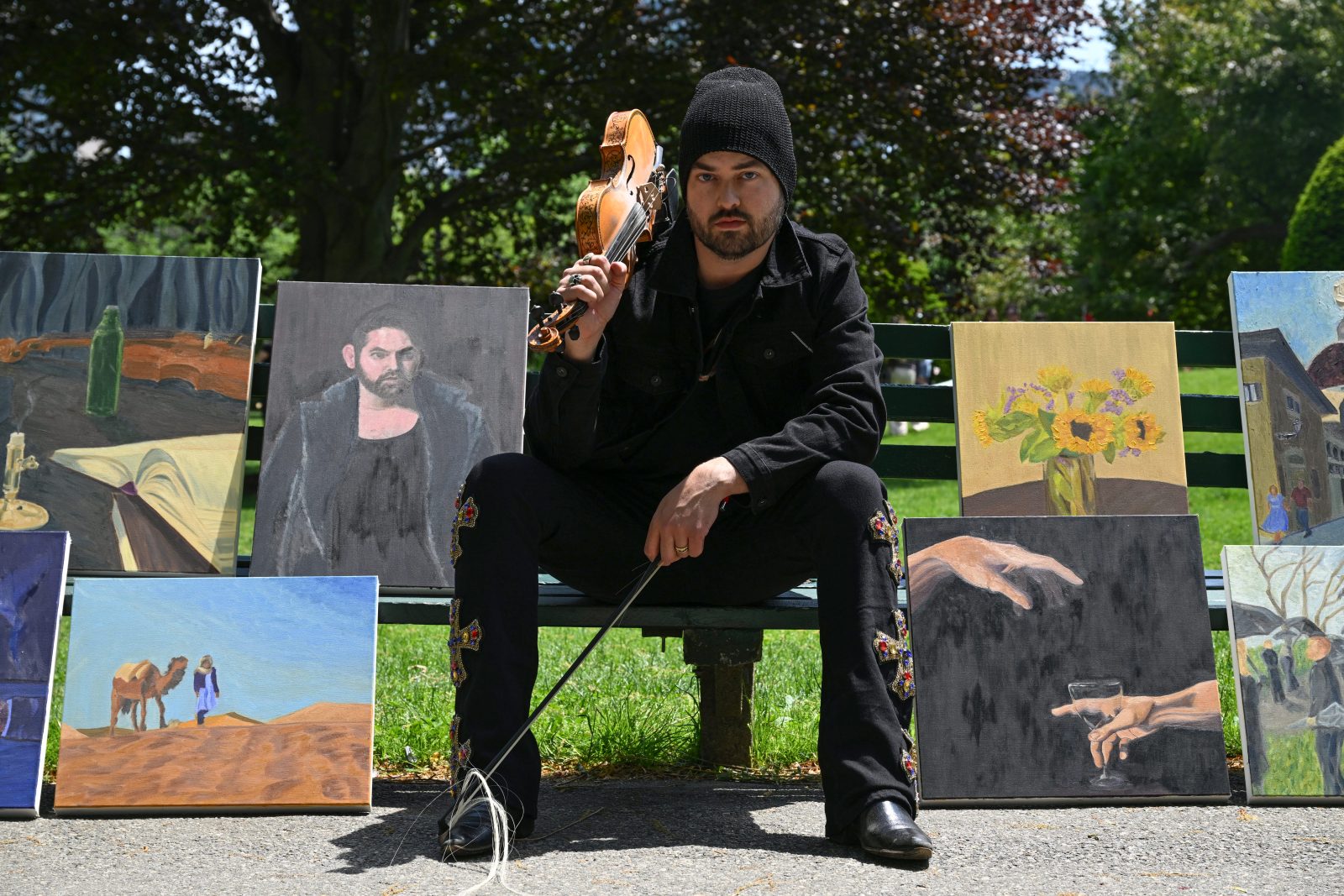
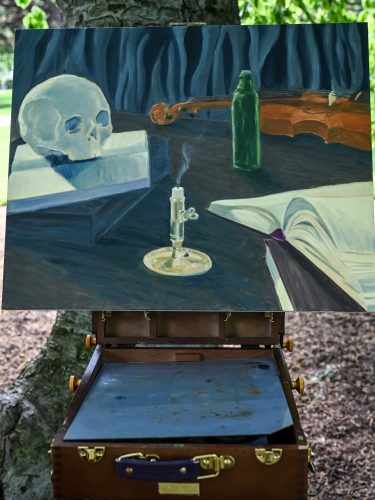
The concept arrived in Florence too. Besides the wedding and the session, the only thing Rhett did on that trip was wander the city looking at Caravaggio and the old masters. So when he sat down to build the album, he decided the record would pay homage to the Renaissance the only honest way he could think of — by becoming, himself, a man who does it all. Twelve songs, each paired with an original oil painting. Hence the title. Hence the whole reckless, magnificent undertaking.
He started with a hand holding a wine glass. Drew it, by his own count, sixty times. Erased and redrew every mark until the shape finally lived on the page, then moved to the next hand, then transferred it in charcoal to a canvas from Michael’s, took a deep breath, and bought oil paints for the first time. That first painting became the cover of the lead single, “Leave the Bottle.” “I felt like jumping off a bridge,” he laughed. “But that was the very first painting I ever did, and it’s what convinced me — okay, if this is my starting point, I think I can do this.”
The learning curve was brutal and specific. He describes the moment he grasped how warm and cool colors work, lit surfaces running warm, shadows going cool and blue, as a genuine mind-blow, the kind of thing that reorganizes how you see. For the self-portrait that accompanies the title track, he could not get one eye right, so he wiped it off and repainted it, over and over, until the painting was done. Afterward he went back and counted the photos he’d taken along the way. He had changed that single eye thirty-eight times.
This is the part Rhett worries is getting lost, and he’s right to worry. “I feel like the paintings aren’t getting their due credit,” he said. “I’ve seen people say they painted their cover art, and it’s a smiley face in spray paint. There was no skill set leading up to this for me. It didn’t exist.” He’s not claiming to be Rembrandt. He’s claiming something more interesting: that the paintings are real work, made from nothing, in the same span most of us spend deciding to start. And his conviction about why he could do it is almost aggressively democratic: “People want to be Michelangelo, they just don’t want to spend their whole lives drawing twelve hours a day. If my next-door neighbor was that dedicated and had the time, they could be the next Michelangelo.” These are not album covers with a violin taped on. They are half the art. Look at the record and judge for yourself.
The music got the same treatment. Rhett had never produced a beat in his life, his old EP, 2015’s Kesha’s Mom, charted on Billboard’s classical crossover list, but even then he’d only written the violin parts over other producers’ tracks. This time he produced every beat himself (“terrible at first,” he admits, before they weren’t), wrote all twelve songs to them, and let no one else touch the record until it was time to mix and master. “The beats are me, good or bad. The songs are me. The art is me,” he said. “If you like it, you’re getting me fully. Nobody else had a hand in this.”
When I’m Dead
The cost of making it that way was disappearing. To learn two disciplines from scratch, Rhett stepped almost entirely off social media for two and a half years, no chasing engagement, no counting likes, none of the machinery that made him. The algorithms did not wait for him. He came back to a Facebook following north of 130,000 that the platform had quietly stopped showing his posts to, and he’s had to rebuild his reach from within his account. That’s the tax on going dark.
And it sharpens the real tension in his story, the one that isn’t going anywhere. Rhett knows exactly how easy the other path is. Covers are views, and views are bookings, the corporate party, the private event, the “I gotta have that guy” of it all. When Kehlani’s “Folded” took off, he knew he could post a cover and collect ten million views by morning. “I’m still tempted,” he said. “I still might.” He’s not pretending to be above the influencer economy that built him. He’s just decided it isn’t the point anymore.
The way he explains that decision is the best thing he said all night, so I’ll let him have it nearly whole. “You don’t go to hear Justin Timberlake sing someone else’s songs. You go to hear Justin Timberlake sing Justin Timberlake songs. Nobody remembers the players in the symphony from five years ago. You remember the composer, the person who wrote it, the artist who created it, because they’re the one who had something to say.” Then the version that will outlive the interview: “When I’m dead, is the Boston Globe going to write, ‘Rhett Price passed away, he was really good at playing other people’s songs’? Who cares.But if people are into Rhett Price’s music, that’s just there, forever. Because it’s me, and it’s my music.”
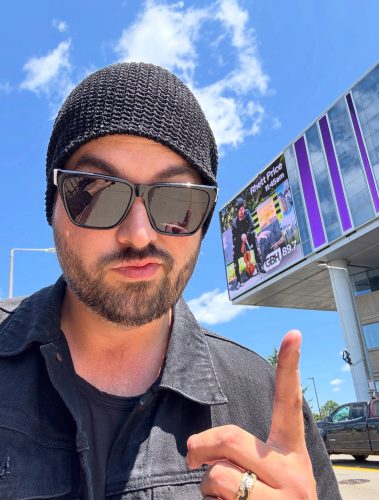
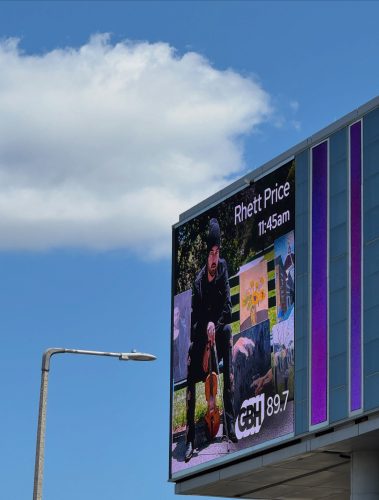
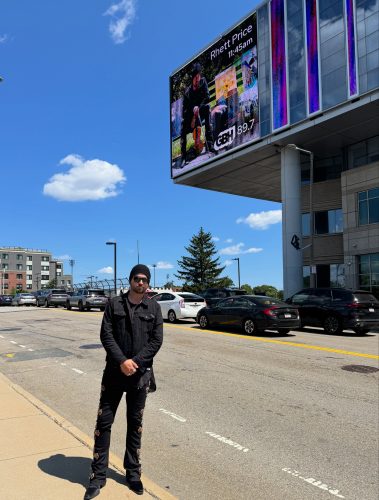
The reception so far suggests the gamble is landing. Touring violinists who play for major artists have slid into his DMs calling the work groundbreaking, calling him a pioneer because nobody else is making original, hip-hop-rooted violin music that doesn’t hide behind a classical costume. He’s co-hosted the morning show at Jam’n 94.5, done Kiss 108, played the GBH culture desk. During a live set at the studio library, a security guard walked over mid-soundcheck to ask where he could buy the record; by the time Rhett sat down after the show, his phone was full of orders. “That guy hears people perform over there constantly,” he said. “And I can guarantee he’d never heard anyone play original hip-hop violin.”
He hasn’t stopped, either — seven new songs written since the July release, and this week he was out in the yard photographing cut sunflowers arranged oldest to youngest, one wilting, one fresh, one in between, a little meditation on mortality he intends to paint in the next day or two. Music first, then the brush; he keeps the two in separate rooms of his head so he can stay in the flow of each. It is not the schedule of a man who pivoted for one album. It’s the operating system of someone who finally figured out what he is.
We’ve watched Rhett Price be a lot of things in these pages. This is the first time we get to call him what the record already does. A Renaissance man, and, at last, entirely his own.