

THE RIVER DOES NOT CARE ABOUT THE PAGEANTRY. Long before the first charcoal-grey smudge of dawn cracks over the Boston skyline, before the corporate tents at Attager Row begin to smell of artisanal espresso and damp fleece, the Charles River is simply an equation of fluid dynamics and unforgiving geometry.
At 6:15 AM on Friday, October 16, 2026, the water was the color of an oily gunmetal sheet, shivering under a steady, cold autumn drizzle.
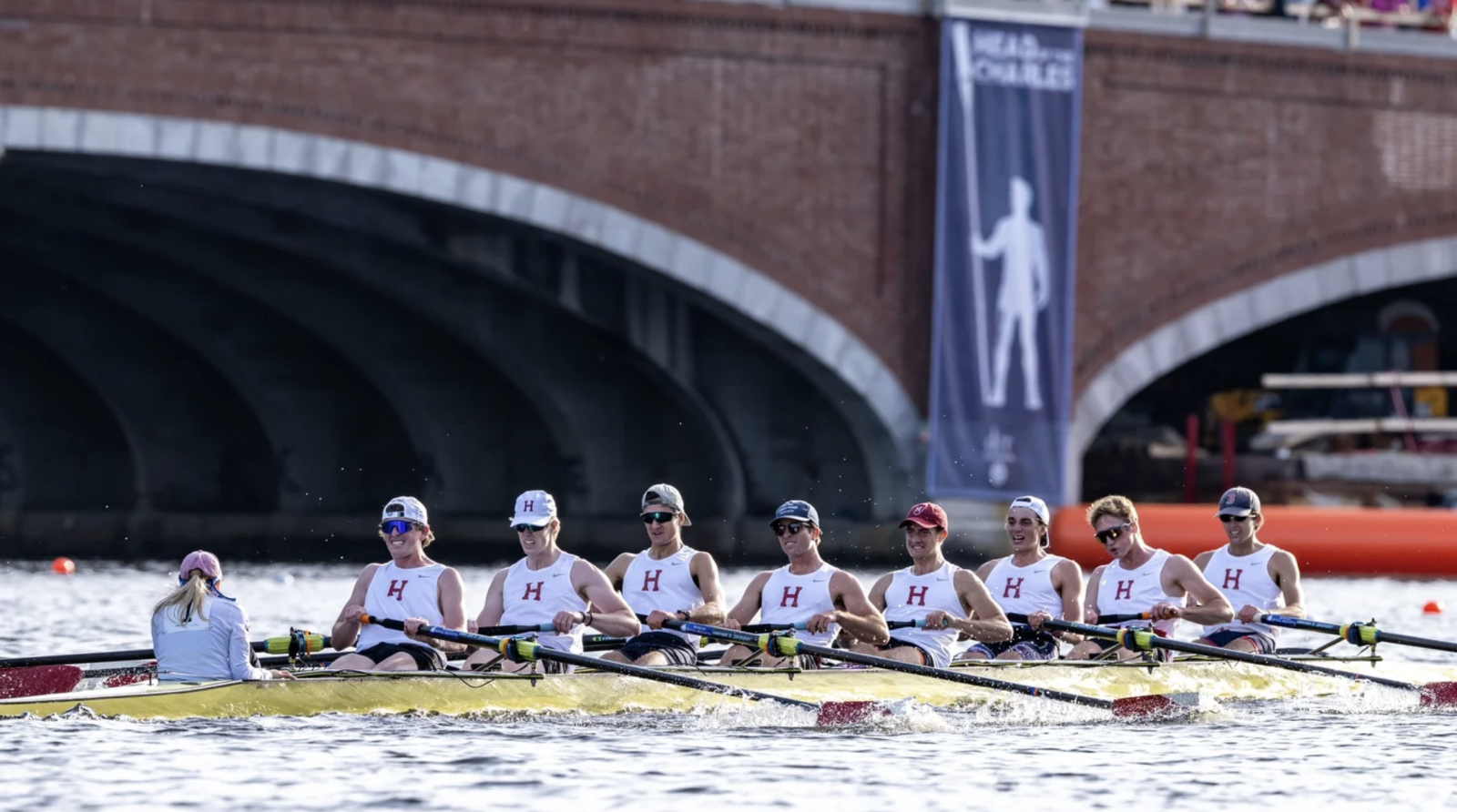
For the master scullers launching their shells from the docks near Riverside Boat Club, this was the moment reality replaced the months of ergometer exile. The air sat at a biting 46 degrees Fahrenheit. Mist hovered over the surface, thick enough to blur the concrete arches of the Boston University Bridge just downstream. The rowers breathed out plumes of white vapor, their hands taped, their minds running through the invisible grid of the three-mile race course.
“You don’t fight the Charles,” whispered Marcus Vance, a 54-year-old single sculler from Seattle, his hands rhythmically checking his oarlock gates before stepping into his carbon fiber shell. “You negotiate with it, and on a morning like this the river’s asking price is incredibly high.”
This was the opening movement of the 2026 Head of the Charles Regatta (HOCR), an event marking its 61st anniversary. What began in 1965 as a modest, late-season time trial conceived by Cambridge boatniks has mutated into what the rowing community universally refers to as “Rowing Christmas”. By noon on Saturday, the quiet, rain-slicked banks would disappear under a shifting mosaic of 400,000 spectators. More than 12,000 athletes hailing from 32 different nations had descended upon the Massachusetts shoreline, transforming a quiet metropolitan waterway into the absolute center of the rowing universe.
Yet, in these early hours, the regatta belongs not to the international superstars or the collegiate powerhouses, but to the veterans. The Men’s Grand Master Doubles and Senior Singles led the charge into the gray.
Their blades clicked in unison—a sharp, mechanical rhythm slicing through the morning stillness. Despite the heavy downpour that slicked the docks and soaked the unheated staging tents, the boat speeds remained remarkably high. It was a testament to a simple truth known by everyone who signs an entry form for this race: the Charles rewards precision, and it mercilessly punishes excuses.

The Genesis: An Act of Cambridge Defiance
To understand why thousands of rowers voluntarily subject themselves to this autumn freezing chamber, one must travel back to 1964. At the time, rowing was dominated by rigid, straight-line 2,000-meter spring sprints. Once the summer ended, boats were traditionally mothballed until spring.
Three members of the Cambridge Boat Club—D’Arcy MacMahon, Howard McIntyre, and Jack Clymer—decided the off-season was too long. Prompted by Harvard University rowing coach Harry Parker, they looked to the traditional “head races” of the United Kingdom, like the Head of the River Race on the Thames, for inspiration. They envisioned a late-season time trial that would keep rowers in their seats through the vibrant New England autumn.
The establishment was deeply skeptical. The Charles River was notoriously difficult to navigate, winding beneath low-slung, multi-arched stone bridges built long before the advent of modern racing shells. Yet on October 16, 1965, the inaugural race took place. It featured roughly 100 boats, mostly local collegiate and club crews. There were no corporate sponsors, no merchandise tents, and no grandstands—just a collection of die-hard oarsmen vying for bragging rights and a hand-crafted medal.
What the founders tapped into was an entirely new athletic subculture. The head race format democratized the sport. It allowed older masters, club rowers, and elite university athletes to share the same water on the same day. It transformed rowing from an exclusive, insular sport into a public spectacle.
Historical Echoes and Waterborne Legends
Over its sixty-one-year evolution, the Charles has transformed from a local time trial into an arena of geopolitical drama, barrier-breaking milestones, and legendary athletic performances.
The Titans of the River
For decades, the standard of excellence on this river was set by Harry Parker, the enigmatic Harvard coach who guided the Crimson for 51 seasons. Parker didn’t just help conceive the race; he dominated it, both through his collegiate varsity eights and his own master sculling appearances.
In the single scull events, names like Gevvie Stone became synonymous with local royalty. Stone, a Boston native and 2016 Olympic silver medalist, won the Women’s Championship Single an unprecedented ten times, utilizing her intimate, lifelong knowledge of the river’s subtle currents to routinely defeat reigning World Champions.
On the men’s side, single sculling icons like Mahé Drysdale of New Zealand and Pertti Karppinen of Finland traveled across the Atlantic to test their Olympic gold-medal power against the river’s brutal bends.
The Crossing of Paths
The regatta has also served as a peculiar crossroads for global celebrities, politicians, and cross-sport athletes. Royal figures, including Prince Albert of Monaco, have famously competed in the master categories. Renowned astrophysicist Neil deGrasse Tyson rowed the Charles during his undergraduate days at Harvard.
In the late 1990s and 2000s, it wasn’t uncommon to spot local political dynasties on the water; members of the Kennedy family routinely raced in club and alumni events. The regatta even attracted elite athletes from other endurance disciplines, such as Olympic cross-country skiers and competitive cyclists, all eager to test their aerobic capacities in the Great Equalizer of a multi-oared shell.
The Anatomy of a Torture Device
To the uninitiated, rowing looks like an exercise in pure aerodynamic engine capacity. To those who race the Charles, it is an intricate game of three-dimensional chess played at an anaerobic threshold that makes the lungs feel as if they are filled with hot broken glass.
The course is a serpentine three-mile stretch starting at the BU Boathouse and terminating just past the Shatterly Boathouse / Herter Park area. Unlike the dead-straight, lane-lined multi-lane courses of the Olympic Games, a head race is a time trial. Boats are sent off at roughly fifteen-second intervals, meaning the winner is determined solely by the stopwatch.
This format shifts an enormous weight of responsibility onto the shoulders of the coxswain—the small person sitting in the stern of an eight or the bow of a four, pulling the rudder strings and executing the race strategy. On the Charles, a great coxswain is worth thirty seconds of pure muscle; a bad coxswain can find themselves wedged against a stone pier, their shell snapped in two, their crew’s season over in a tangle of splintered carbon and screaming officials.
The undisputed crucible of the entire course is the Weeks Footbridge. Approaching Weeks, the river makes a violent, sweeping turn to the port side. If a coxswain turns too early, they clip the shallow mudbanks on the inside of the bend. If they turn too late, they swing wide into the path of oncoming boats or get pushed out into the dead water on the outside of the turn, losing precious seconds.
At the 2026 Regatta, the banks at Weeks were packed ten-deep with spectators holding plastic cups of cider, waiting for the inevitable “clack-clack-clack” of carbon oars colliding as three boats attempted to squeeze through an opening designed for one. It is the closest thing rowing has to a NASCAR short-track short corner, a theater of high-stakes navigation where shouting matches between crews can be heard clearly over the roar of the crowd.
Saturday: HOCR 2026’S Historic Milestone
By midday Saturday, the rain of Friday had given way to a classic New England autumn afternoon: a brilliant, crisp sky with a cross-tail wind that churned small whitecaps on the broader expanses of the basin. The smell of frying cider donuts from the Weld Exhibition vendors hung heavy over the bridges.
The defining centerpiece of the 2026 Saturday schedule was a profound historical milestone: the official celebration of 50 years of women’s Olympic and Paralympic rowing.
In 1976, the Montreal Olympic Games opened their doors to women’s rowing crews for the very first time. To honor that trailblazing generation, the HOCR organizers brought together surviving members of those historic 1976 crews.
Watching these women—now in their late 70s—step back into racing shells at the Newell Boathouse was a lesson in the enduring nature of muscle memory. Their movements were slower on the docks, but the moment their blades hit the water, the decades dissolved. They rowed with the long, low-profile, classic style of the wooden-boat era, their bodies moving in a synchronized swing that had been forged in the crucible of Title IX battles half a century ago.
Sharing the water with them were the athletes representing the next half-century: elite under-23 and senior national team rowers who are actively targeting the Los Angeles 2028 Olympic Games. The juxtaposition was stark and beautiful. In the Club and Championship events, women were rowing with an athletic intensity that would have been unimaginable to sports scientists in 1976.
Among the local collegiate powerhouses, the home-river advantage paid massive dividends on Saturday afternoon. The Boston University Women’s Rowing program set the banks on fire in the Women’s Club Four+event. Coxed by junior Molly Bernardo and stroked by senior Ruthie Wix, the BU boat tore through the three bridges with a breathtakingly aggressive line, crossing the finish line at 19:08.842 to secure the gold medal.
It marked BU’s first victory in that specific event since 2011, triggering an absolute uproar from the alumni gathered at the BU Boat House.
“We knew we had the fitness, but on this river, you need the line,” Wix said, her face still splattered with dried river mud and sweat after her race. “Molly [Bernardo] took us so close to the stone piers at Anderson that I could hear our oartips buzzing against the masonry. That’s how you win the Charles. You have to trust your coxswain with your life.”
Not far behind them, other historic programs made their marks. The Fairfield University Women’s Rowing team put together an unprecedented performance, capturing 9th place in the highly competitive Club Four field with a time of 19:36.35—the university’s very first top-10 finish in that event at the Charles. Further down the results sheet, programs like the University at Albany battled through a 48-boat field to finish 20th, proving that the depth of collegiate women’s rowing has expanded exponentially since those pioneers of 1976 first put blade to water.
Sunday: The War of The Youth & The Elites
If Saturday is about history and club pride, Sunday at the Head of the Charles is about the cutthroat future of the sport. The morning opened with the Youth Eights—the premier high school and club events that serve as an early-season testing ground for junior rowers eyeing the US Rowing National Championships and the Henley Royal Regatta.
The Men’s Youth Eight event is always a chaotic, high-octane affair. These are crews of teenage boys, averaging six-foot-three and packing near-elite physiological engines, but often lacking the cold, calculating restraint required to handle a crowded head race. The traffic was unrelenting. From the Riverside turn up through Weld Boathouse, boats were overlapping constantly. The air was filled with the rhythmic thump of high-rate strokes and the frantic, amplified commands of coxswains shouting through their speakers: “Yield! Yield! Get out of our water!”
By early afternoon, the clouds thickened again, bringing a sharp, whistling headwind to the final mile of the course—the wide, exposed basin leading toward Herter Park. This is where the true “Championship” events took place. This is where Olympic silver and gold medalists from Paris sat in the same staging lines as collegiate varsity athletes from programs like Princeton, SMU, and international entries from Cambridge and Oxford.
The Women’s Lightweight events provided a masterclass in technical efficiency under pressure. The Princeton women’s lightweight program, fresh off their fifth-straight Commissioner’s Cup victory at the IRA National Championships, launched their Varsity 4+ and 8+ shells into a viciously choppy headwind. Watching a lightweight crew handle a headwind is like watching a Swiss watch operate inside a rock tumbler. Without the raw, heavy mass of openweight athletes, lightweights must rely on absolutely immaculate blade entry and a razor-sharp catch.
As the Princeton lightweight eight surged past the Cambridge Boat Club docks, their rating sat at a blistering 36 strokes per minute, their blades feathering mere inches above the whitecaps. There was no hesitation, no check in the boat’s run. It was a stark reminder of why the Charles is considered an unmerciful arbiter of rowing style: if your technique has a flaw, the river’s wind will find it and exploit it in front of thousands of screaming fans.
The Community of The Oar
To focus entirely on the gold medals and the elite times is to miss the true soul of the Head of the Charles. The regatta is a massive, sprawling cultural ecosystem that takes over the cities of Boston and Cambridge for seventy-two hours. It is powered by an army of 1,800 to 2,400 volunteers who handle everything from dock-brooming to high-speed medical launches.
Walk through the Eliot Bridge Enclosure on Sunday afternoon, and you will find an interesting cross-section of global rowing society. You will see British rowing jackets dating back to the 1970s, faded Ivy League unisuits worn by tech executives who haven’t sat in a boat since graduation, and parents from the Midwest wrapped in heavy wool blankets, tracking their children’s split times on mobile apps.
There is an emotional weight to this gathering. Rowing is a sport of deep anonymity. For most of the year, these athletes train in the freezing dark of 5am mornings on isolated lakes and forgotten industrial rivers; their efforts witnessed by no one but a coach shouting through a megaphone from a battered launch.
But for one weekend in October, they are rock stars. They row through an amphitheater of human noise.
As the final collegiate eights crossed the finish line on Sunday afternoon, the sun briefly broke through the autumn clouds, casting a long, amber light across the waters of the upper basin.
The rowers collapsed over their oars, their chests heaving, their faces etched with the profound exhaustion that only a three-mile head race can produce. Behind them, the coxswains reached forward to pat their shoulders, their voices hoarse from three miles of screaming.
The 2026 Head of the Charles was over. The boats would be disassembled and packed back onto long steel trailers; the tents at Attager Row would be struck down; and the river would be returned to the local mallards and the quiet morning practices of the local clubs.
But the stories written over those three miles—the split-second lines at Weeks, the gold medals won by inches, and the old pioneers who proved that the spirit never ages—would be carried back to thirty-two countries, whispered over ergometers all winter long, until the autumn leaves turn red once again.
______
For complete results and more information on the 2026 Head of The Charles Regatta please visit HOCR.org.
