
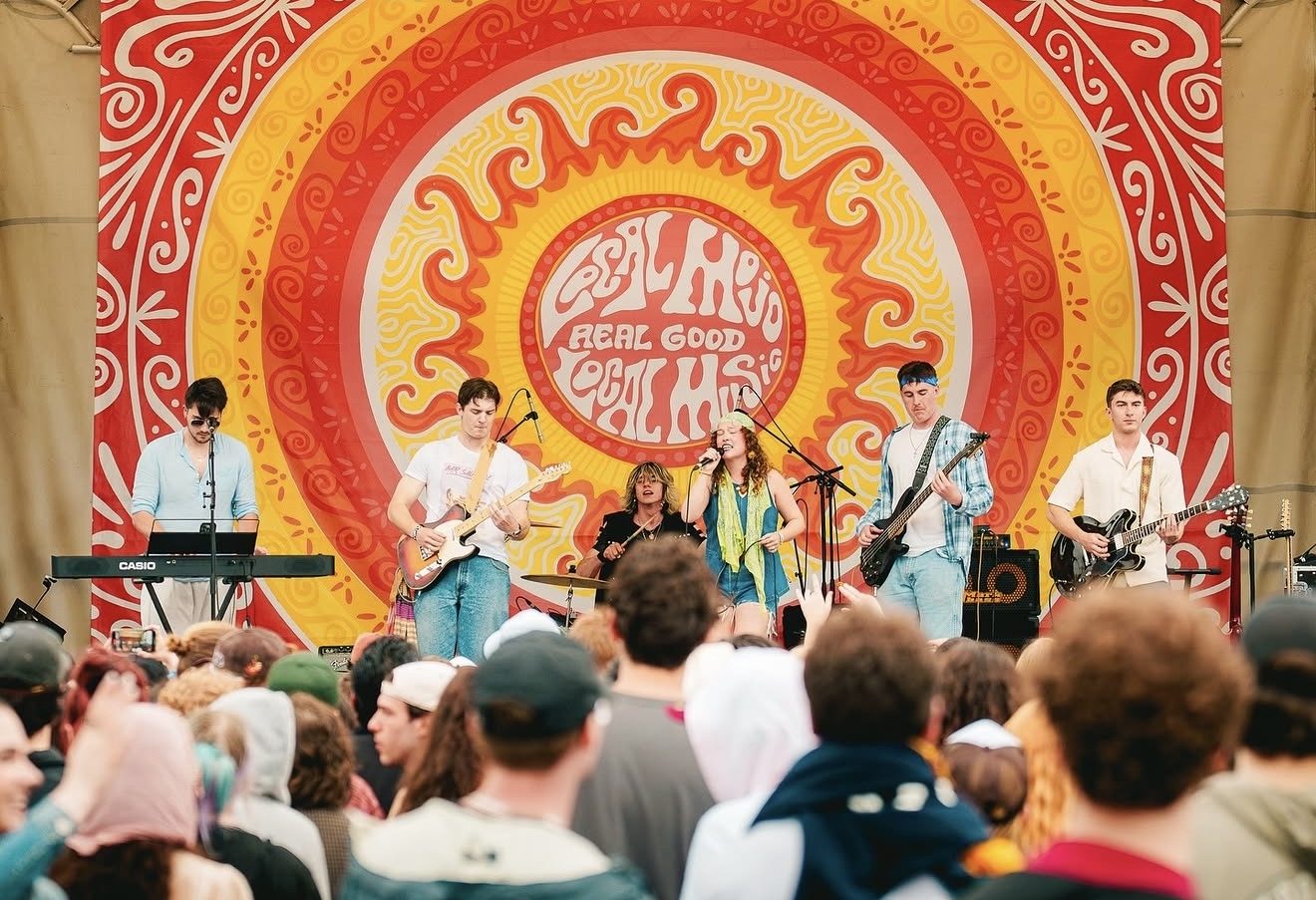

The ‘twenty-somethings’ behind Local Mojo built a grassroots music movement from a dorm room to City Hall Plaza — and they’re just getting started.

THE PHONE connects, and there’s noise in the background. Not chaos exactly, but energy. The kind that hums through walls when something is about to happen. Charley Blacker and Alex Parker, co-owners of Local Mojo, are calling from a hotel room in Boalsburg, Pennsylvania. A music festival at Penn State is less than 24 hours away. Em Donovan, their Boston director and original crew member, is back in Southie holding things down on the other end. Boston can wait a few minutes.
This is the thing you need to understand about these guys before you understand anything else. They are never not moving. There is no offseason. No coast. The apartment they share in South Boston — where the three of them have planted the Local Mojo flag — has walls covered in whiteboards. Goals. Plans. The next city. The city after that.
“I can’t go to bed,” Blacker has said, “because I’m just thinking about new projects or new, exciting things.”
He’s 23 years old.

The Origin
It started, as the best things often do, with a problem nobody else was trying to solve.
It was November 2021. Blacker was a sophomore at the University of Massachusetts Amherst, a school better known for its party culture than its music curation. He was going to concerts in people’s basements. He was watching bands play to 40 people and thinking they deserved 400. He didn’t wait for someone else to figure it out.
“We were going to these concerts in people’s basements,” Blacker recalls, “and we’re just like, these musicians are sick. We need to find a way to market them and get them in front of more people and make them kind of local celebrities.”
He brought in two friends — Cashel Davis and Jack Krause — and the three of them created the name Local Mojo. The mission was simple and specific: give local artists the platform they deserved. No corporate backing. No university affiliation. No permission from anyone.
That first year was pure hustle. No events. Just networking. Showing up. Meeting bands. Learning the scene. Emily Donovan, then a fellow sophomore studying communications, heard what Blacker was building and reached out. She joined. The team set up tables in front of Berkshire Dining Commons and handed out stickers, trying to get the name out. It was, as Donovan has described it, “very much a homemade effort.”
Then they started throwing shows.

Not venues at first. Backyards. Basements. But they did the work right — artist interviews, music videos, media packages. They treated local bands like they mattered, because they did. The audience responded. Local Mojo started filling rooms on nights that rooms weren’t getting filled. They would take a slow Thursday at a bar in Amherst, bring in their DJs spinning house music, and the line would stretch down the block.
“We would bring in house music, stuff that people in Amherst weren’t really used to,” Blacker says. “We would turn it into a house music function and the line would go down the block for a day that they usually weren’t busy.”
Thursday. Friday. Saturday. An event every single night.

The Festival That Proved It
When you have the audience and the bands, a music festival is the logical next step. Local Mojo’s first one was held in the backyard of a friend’s house in Amherst. They built a stage out of pallets. They called in a buddy with sound equipment. They brought in their friends’ bands. Between 1,500 and 2,000 people showed up to someone’s backyard to hear local music done right.
That was the proof of concept. Everything since has been scaling that moment.
The festivals grew. First to legitimate venues around Amherst — The Spoke, The Drake, Garcia’s. Then to a full festival in Hadley, Massachusetts, at The Club, where over 5,000 people descended on a field in April rain, stayed through the mud, and called it one of the best days they’d had. It was, by any measure, the largest and most successful event that venue had ever seen.
Five thousand people. In the rain. For local music.
That’s not an accident. That’s a movement.

The Villain in This Story
To understand why Local Mojo matters, you have to understand what they’re up against. And what they’re up against isn’t just a competitor. It’s an entire system.
Live Nation and Ticketmaster merged in 2010. They now control an estimated 70 percent of major venue ticketing in the United States. They own or operate over 200 venues globally. When they control the room, they influence the booking. Independent promoters get pushed out. Local acts can’t get slots. The ladder that used to exist — play the small room, build a following, move up — has been effectively pulled up behind the people who already made it to the top.
The ticket prices tell the story plainly. The average concert ticket price has more than doubled in the last decade. Dynamic pricing. Platinum seats. Service fees stacked on service fees. Live music is becoming a luxury product. The kid who would have discovered their favorite band at a $15 show in a sweaty club in 2005 has no equivalent entry point in 2026.

Parker sees it with particular clarity, coming from the operational side of what Local Mojo does every day.
“People have been brainwashed,” Parker says. “They think that going to a concert — people just see the norm as the corporate concert. Going to a Live Nation event, spending $300 on tickets, $18 on a beer. People just know that for concerts nowadays, with everything going on — buying up venues, buying up promoting networks.”
And it’s not lost on Parker what that backdrop means for what he and his partners are doing. “It’s a big shock to industry professionals,” he says, “to see two kids, 23 years old, living in South Boston, Massachusetts. We have a whole big team, but it’s a bunch of young people putting this on.”
That Goliath isn’t a monster. It’s a system. Systems are harder to fight than monsters.
When the comparison comes up explicitly in conversation — David versus Goliath — Parker doesn’t reach for a metaphor. He just states the reality.
“It is Goliath,” he says. “These guys own everything. It’s insane.”

David’s Sling
Here’s what Local Mojo’s weapon looks like: a community that believes in the thing.
It’s the most old-fashioned tool imaginable. And it’s the one thing Goliath can’t manufacture, no matter how much money it spends.
You can buy a playlist placement. You can’t buy the feeling of being in a crowd that discovered something together. You can buy a venue. You can’t buy the loyalty of a college town that watched two kids build something from nothing in their own backyard and decided to show up for it.
When the model worked in Amherst, students who’d experienced it went home to their own schools and said: we need this here. That’s not promotion. That’s conversion. That’s what movements do.

“People that take the chance on Mojo are always — humbly — they’re always blown away by what we can do when the community comes together,” Blacker says. “Focusing on the community and just the local music scene. It’s such a powerful thing.”
The growth has been exactly that. Exponential, and built on believers rather than budgets.
“I love the growth,” Parker says. “It’s cool to go to different parts of the country and bring our brand there and build out more fans — but also the bands that travel along with us.”
That last detail matters. Local Mojo doesn’t just plant a flag in a new city and leave. They bring the artists with them. One band in particular — Morrissey Boulevard — has become the living embodiment of the model. Parker is unambiguous about his investment in them.
“They’re playing all three festivals,” he says — Amherst, Penn State, and Boston. “They’re the band I put all my chips in on. I think they’re absolutely insane.”
That’s grassroots music development in its purest form. Not a label discovering a band after they’ve already built a following. A movement building the following alongside the band, city by city, festival by festival, together.

The Boston Chapter
When Local Mojo moved its headquarters from Amherst to Boston, it wasn’t a pivot. It was an expansion. Blacker, Parker, and Donovan set up in Southie and got to work building the scene the same way they’d built it everywhere else — from the ground, one room at a time.
They’ve taken over UFC gyms. Pickleball spots. Irish pubs. They’ve run house music events and band showcases and built a loyal following in a city that doesn’t give its loyalty easily. And now that Boston chapter has its biggest moment yet.
City Hall Plaza. May 9th. Noon to 10:30pm.

Two stages. Ten hours of music. National headliners AC Slater — a bass house pioneer — alongside tech-house artist Discip. Local talent including The Bends and The Gringos. Dozens of vendors. Live art. Food trucks. The full Mojo experience, delivered to the heart of Boston starting at $40.
Forty dollars. Ten hours. Two stages. One of the most iconic civic spaces in America.
Parker, who handles the operational side of making all of this actually happen — the permits, the logistics, the infrastructure that turns a vision into a festival day — speaks about the venue with genuine reverence.
“It’s a historic spot,” Parker says. “There have been a lot of cool concerts there. Notorious B.I.G., Mac Miller.” He pauses, then gets practical. “It’s super accessible for the whole city. Right in the heart of downtown Boston. You can get from pretty much anywhere in Boston to there within 20 minutes on the MBTA.”
Then he zooms back out. “We’re fortunate. The city worked with us really well in putting this together. And yeah — we’re super pumped.”
Boston’s music history runs deep and wide. The Pixies formed at UMass. Aerosmith came out of the Boston club circuit. The Cars. Morphine. Throwing Muses. The New England grassroots scene has a legitimate claim to shaping American music. Local Mojo isn’t borrowing that tradition. They’re continuing it.
“Boston has such a rich and deep history of music culture,” Blacker says. “We want to really give it to the people. Book these local bands and put on a show really for the people. By a bunch of kids just living in Southie. This is as grassroots as it gets.”

The Offers They’ve Turned Down
Here’s the part of the story that tells you everything about who these people are.
The calls have already come. The industry has noticed. People reaching out every day now, wanting to help, wanting to invest, wanting a piece of what Blacker, Parker, and Donovan have built. Every single day.
They’ve said no. Every time.
Parker is direct about it, with a clarity that sounds less like defiance and more like simple math.
“We just have such big goals that no matter what — they come to us — we’re not at our goals yet,” he says. “And I don’t think we’ll ever be at a spot where we’re going to want to do that. We’ll never compromise on our mission of supporting local music and the grassroots movement. That’s literally what makes Mojo so successful. You take that away and it’s not the same.”

They are cautious about who they partner with. Not just the big corporate offers — even smaller partnership deals get scrutinized against the mission. Does this help local artists? Does this serve the community? Does this compromise what made this thing worth building in the first place? If the answer to that last question is yes, the answer to the partnership is no.
“We’re young,” Parker says simply. “We don’t want to be compromised.”
Blacker echoes it with the same quiet certainty. “We’re only answering to ourselves right now. And that’s what makes all this work worth it.”
The Movement Continues
The Mojo Boston Music Festival on May 9th is not a destination. It’s a waypoint.
After City Hall Plaza, there’s the Southeast, where Parker says the live music scene is surging. There’s San Diego, where Local Mojo is planning a festival for next spring. There’s whatever city reaches out next because someone who was in that muddy field in Hadley, or a backyard in Amherst, or a basement show at Penn State, went home and said: we need this here.

Parker puts the trajectory plainly. “There’s a lot more in the pipeline. In the next year, next two years — the growth is going to put a lot of people on notice.”
The movement now spans eight communities across the United States and continues to expand, not because of corporate strategy or investor capital, but because the idea is portable and the community is real. Blacker puts it best when he describes what separates what they’ve built from everything else operating in the same space.
“Showing people in the world that grassroots music — being in it for the right reasons — it’s powerful,” he says. “People will respond overwhelmingly well to this grassroots mission.”

On May 9th, two stages go up at City Hall Plaza. Ten hours of music. Forty-five dollars at the door. A crew from South Boston who built something real, by hand, city by city, and brought it home.
Goliath owns the arenas. He controls the algorithms. He sets the prices and charges the fees and bought the venues and the ticketing platforms and the promotion networks. He spent twenty years making sure people like Charley Blacker, Alex Parker, and Em Donovan never get in the door.
They’re not at the door.
They’re at City Hall Plaza.
David doesn’t sell the sling.
The Mojo Boston Music Festival takes place May 9, 2026 at City Hall Plaza in Boston. Doors at noon, music until 10:30pm. Tickets available at localmojobrand.com.
