
LOOK I’M NOT SAYING MY SLEEP HABITS ARE IN JEOPARDY, but if I get one more text at 2AM from a prominent NBA observer that just reads “1990s Rockets/2010s Thunder re-roll choice, emergency call needed,” I might have to change my number.
It starts with that digital click. The frictionless whir of a simulated wheel on your phone, a flash of vintage kelly green, and suddenly you’re staring at it:
1980s. Boston Celtics.
If you’re a basketball purist sitting anywhere inside the Interstate 95 loop, your pulse immediately hits 110. Your brain goes into overdrive. Do you lock in ’86 Larry Bird, the Basketball Jesus, at small forward right now and bank the ultimate competitive-edge guy? Or do you get greedy, burn your single allotted decade re-roll, and pray for a 2012 apex Miami LeBron or a 1962 Wilt Chamberlain?
Welcome to 82-0, the deceptively simple, deeply addictive browser-and-app game that has evolved from an underground internet obsession into a genuine cultural pandemic. In executive boardrooms, high-end downtown Boston dining spots, and actual NBA locker rooms, everyone is chasing the same elusive holy grail: a perfectly simulated, undefeated 82-game regular season.
Even the league’s elite aren’t immune. Tyrese Haliburton—who is basically the patron saint of modern NBA hoop nerds—famously posted his absolute exasperation to social media after putting together an absolute powerhouse roster that the game’s engine brutally graded at 77-5. “Retiring from 82-0 cuz stop it,” he tweeted.
He didn’t retire, of course. Nobody does. It’s digital crack.
The Anatomy of the Addiction
Created by developer Roy Saar and scaled globally via gaming incubator PlayVault, 82-0 targets the exact psychological intersection of sports trivia, fantasy drafting, and statistical optimization. It takes less than two minutes to play out, which is why you can casually lose four hours of your life to it on a Sunday afternoon.
The premise:
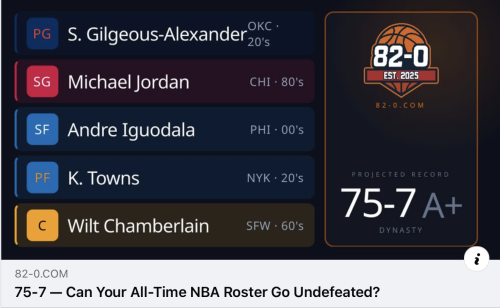
The Draw: The game hands you five randomized combinations of an NBA franchise and a specific decade.
The Draft: From each draw, you must pick exactly one player who suited up for that team in that era to fill out a standard PG-SG-SF-PF-C lineup.
The Sim: Once your starting five is set, the game’s algorithm digests real-life historical stats, factors in an “era-adjustment” formula, and spits out your final record.
For the casual fan, it’s a nostalgic trip down memory lane. For the data-driven professional, it is a brutal exercise in spreadsheet warfare. The algorithm doesn’t care about your feelings, it doesn’t care about “clutch gene,” and it severely punishes teams with a glaring “weak link” starter. If you draft a shooting guard who averaged 6 points a game just to save a re-roll, the machine will find him, and it will destroy you.
The “Inside the NBA” Treatment: Going Live from Atlanta
Nothing solidified the game’s mainstream cultural ascendancy quite like its inclusion on television’s most iconic sports studio show, Inside the NBA.
To close out a broadcast, host Ernie Johnson introduced a custom version of the game built specifically for the studio, triggering an immediate, predictable wave of competitive chaos among the analysts. Naturally, the crew spent half the segment trying to draft themselves—Kenny “The Jet” Smith instantly locked eyes on his 1990s Houston Rockets persona, while Shaquille O’Neal boisterously campaigned for his dominant 1990s Orlando Magic or 2000s Los Angeles Lakers eras.
As the simulation engine compiled their combined “Inside Guys” dream team, Charles Barkley provided his trademark skepticism, loudly questioning whether the algorithm factored in “who was actually going to pass the ball to… well, anyone.” When the game simulated their final tally and ultimately awarded them a flawless, perfect 82-0 record, Shaq wasted zero time rubbing it in Chuck’s face—reminding him that a perfect season is just another championship ring he wouldn’t be able to fit on his fingers. It was viral gold, turning a browser game into the center of the basketball universe for a night.
The “Cheat Codes” and Decoding the Algorithm
Like any viral gaming phenomenon, a community meta has rapidly formed. Spend enough time on sports media networks, TikTok, or the deep corners of basketball subreddits, and you’ll find prominent analysts locked in heated screen-sharing battles trying to out-draft one another.
The question everyone wants answered: Does the algorithm actually understand basketball IQ, real-court spacing, and team chemistry—or is it just raw, ruthless math?
As it turns out, the internet’s premier data sleuths have largely cracked the code. Programmers on platforms like Reddit’s r/82and0 community ran massive data regressions on thousands of simulated outcomes. Their findings stripped away any romantic notion of “five guys learning to play together.” The simulation isn’t projecting complex psychological chemistry or dynamic locker-room synergy; it’s a linear mathematical machine that weights a player’s peak decade per-game statistics.
Crucially, developers built a “non-linear simulation engine” to handle era adjustments. But the real secret weapon to hitting 82-0 lies in understanding that the formula heavily rewards defensive counting stats—specifically steals and blocks—and triple-double multipliers.
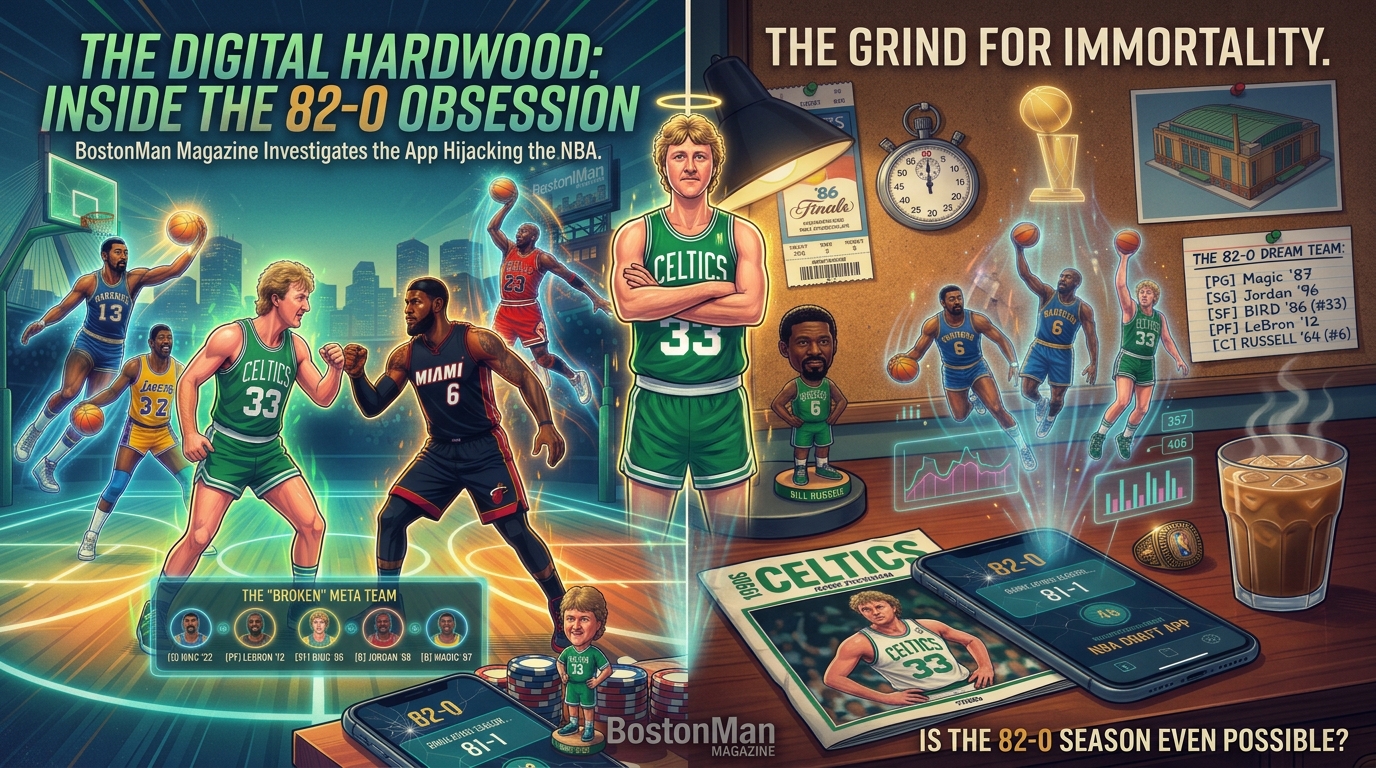
Armed with this knowledge, players have architected the ultimate “broken” theoretical roster. It requires a perfect storm of five precise decade-and-franchise spins to build:
[C] 1960s Golden State/Philadelphia Warriors — Wilt Chamberlain: The cornerstone. He injects an ungodly statistical baseline of over 40 points and 25 rebounds per game. The engine scales his missing era-specific defensive data so generously that he single-handedly inflates a team’s floor.
[PF] 2020s Denver Nuggets — Nikola Jokić: Stacking a prime Jokić at power forward completely manipulates the simulator. His modern triple-double status provides an elite, hyper-efficient scoring profile while throwing massive passing and rebounding multipliers onto the team total.
[G] 2020s Washington Wizards — Russell Westbrook: While basketball purists argue over his real-life efficiency, Westbrook’s historic Washington stretch is an algorithmic nuclear bomb. The game can’t handle a point guard averaging 22.2 points, 11.5 rebounds, and 11.7 assists; it breaks the engine’s standard positional expectations.
[SF] 2010s Miami Heat / Cleveland Cavaliers — LeBron James: The definitive anchor for the small forward slot. Peak 2010s LeBron gives the math machine exactly what it wants: massive raw point generation paired with an elite defensive floor (blocks and steals) that caps the opposing simulated team’s output.
[G] 1980s Chicago Bulls — Michael Jordan: To complete the backcourt, the ultimate cheat code is pulling an early-era MJ. His 1987–1988 season—where he averaged 35 points per game alongside an absurd 3.2 steals and 1.6 blocks—supercharges the algorithm’s perimeter defense metrics while rendering the team completely unbeatable.
(Hold on. Timeout. I need to issue a massive, red-alert disclaimer here. If the Martians land tomorrow, laser beams pointed at the planet, and Max Kellerman is screaming about the fate of the universe depending on one single, do-or-die game of basketball—this is NOT the five-man unit I am sending out there. It’s just not. In a real-life, blood-and-guts, winner-take-all basketball game against the aliens, my squad absolutely, beyond any shadow of a doubt, features 1980s Larry Bird diving for loose balls and 1960s Bill Russell anchoring the paint, winning every psychological war before the opening tip. But we aren’t playing on real parquet here; we are completely conforming to the cold, unfeeling analytics of a digital formula. Back to the spreadsheet.)
For the true basketball purists, “Classic Mode” (which openly displays player stats during the draft) is merely the training wheels. The real elite migrate to HoopIQ Mode, where the numbers are completely hidden. To survive there, you must rely entirely on raw, unassisted memory of historical basketball rosters and box scores—manually guessing which players possess the stat-stuffing profiles the machine craves.
The Executive Takeaway
Look, at its core, the obsession with 82-0 mirrors the exact executive mindset that defines modern sports analytics and corporate culture. It forces you to operate under strict constraints, manage unexpected volatility, and optimize resource allocation under pressure. It’s the ultimate test of decision-making.
But more than that, it reminds us why we fell in love with sports storytelling in the first place: the endless, beautiful, unresolvable debate of how different basketball eras stack up, interact, and survive against one another.
So the next time you see a colleague or a fellow executive staring intently at their phone at a local networking event, they might not be answering a critical, late-afternoon email. They might just be one perfect point guard away from basketball immortality. Or, you know, they’re just cursing out a simulated 79-3 season -or in my case, as of this publishing my best tally of 75-7- like the rest of us.