
How a Hallway Conversation, a World Series Promise, and One Unplugged Guitar Built Boston’s Most Beloved Fundraiser.
IT WAS NOVEMBER 2000. Boston Herald sportswriter Jeff Horrigan was waiting in line at the Paradise Rock Club on Commonwealth Avenue when a poster caught his eye. Not the headliner. The opening act: a band called Thurman Munson.
He turned to his friend Casey Riddles and said he knew a guy in a band in Brooklyn called Carlton Fisk. What if you put them both on a bill? What if you made it a fundraiser? What if you called Peter Gammons?
That conversation in the Paradise’s front hallway — cold night, crowded room, a Superdrag show about to start — planted the seed for what would become one of the nation’s longest-running fundraiser concert series. The idea was simple enough: gather Boston’s baseball world and its music world, put them on one stage, and do some good. Twenty-six years later, Hot Stove Cool Music fills that same room every January, and the waitlist to be part of it is longer than the one to get into Fenway on Opening Day.
The name, for the record, was not Horrigan’s. That credit goes to a friend of the group named Mark Quigley, who suggested wordplay built around “hot stove” — the ages-old term for off-season baseball chatter. Cool music. Hot stove. Done.
Within three weeks, they had a lineup. Within a month, they had nearly sold out the Paradise on a frigid Monday night, one week before Christmas, and raised $17,000 for the Jimmy Fund. By the time the night was over, they were already planning the next one.
Win a World Series First
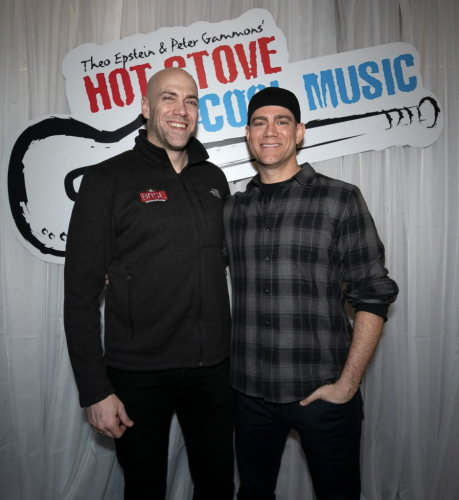
To fully understand what Hot Stove Cool Music has become, you have to understand the other story running alongside it. The quieter one. The one about a social worker from Brookline who had been nudging his brother for years before anyone outside of Boston knew either of their names.
Paul Epstein — Theo’s twin brother, co-founder of the Foundation To Be Named Later, and the man who has arguably done more behind the scenes for Boston’s youth than almost anyone in the city — had been lobbying Theo since the moment he took the Red Sox job in 2002.
“I’m a social worker,” Paul told me when we sat down recently. “And he had reached this sort of apotheosis of fame in Brookline. I wanted to use his newfound status as a celebrity to generate some dollars for charity.”
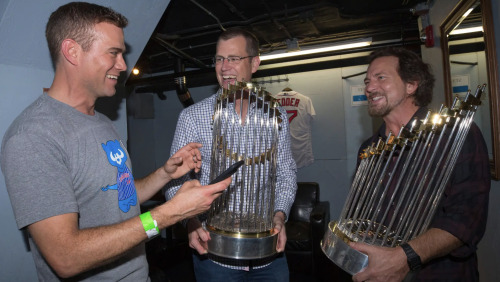
Theo’s response was measured, confident, and — in hindsight — vintage Theo. He told Paul he was absolutely in. Just not yet. Get settled. Get comfortable. Win a World Series. Then they’d do it.
Paul waited. And in October of 2004, the Red Sox did the thing that 86 years of Boston fandom had begun to believe might never happen. They won it all. Broke the curse. Sent an entire city into a months-long delirium.
Paul gave his brother approximately zero time to enjoy it.
“He was basically still drunk from partying after the World Series,” Paul says, grinning at the memory. “And I called him up and said, ‘All right. It’scharity time.'”
They spent the next several months planning, and in 2005 the Foundation To Be Named Later officially launched. The name itself came not from a stroke of creative genius, but from the particular exhaustion of people who had been going in circles for too long. “One of us got tired of kicking around ideas,” Paul recalls. “We said, ‘Screw it, we’ll name it later.’ Thus, the Foundation To Be Named Later — because baseball pun embedded in it.”
It is, as Paul notes, a perfect litmus test. If you’re not a baseball fan, you ask why. If you are, you just get it.
The Merger That Made History
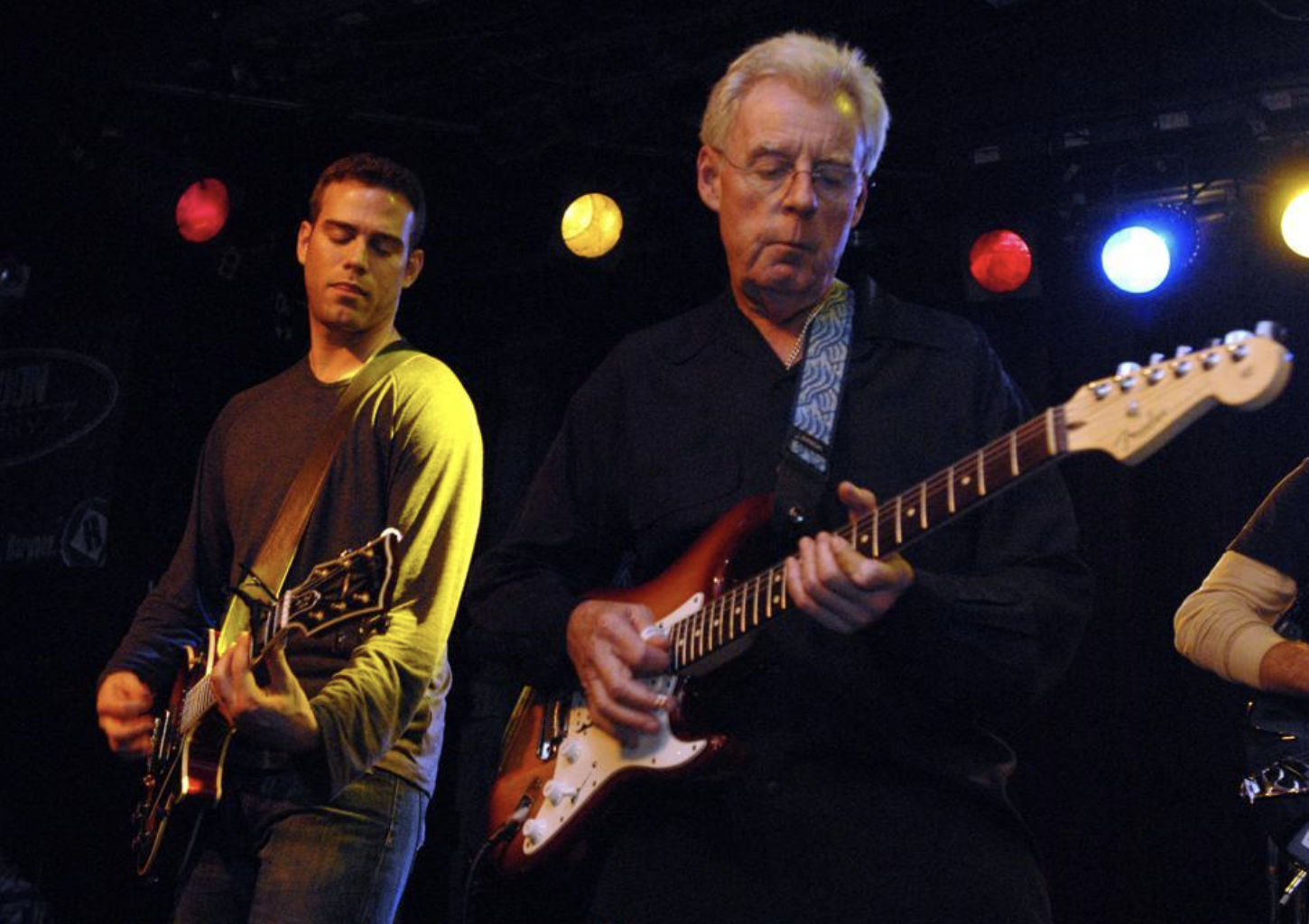
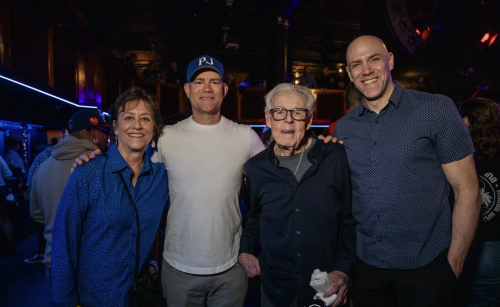
Hot Stove Cool Music had existed on its own for five years before the Foundation came along. Peter Gammons and Jeff Horrigan had built it from scratch — that one cold Monday at the Paradise, a hasty three-week planning window, a near-sellout crowd, and $17,000 raised for the Jimmy Fund. By year three, Gammons was fronting his own all-star band on the HSCM stage, picking up a guitar for the first time since his college days at the University of North Carolina. By year four, a guitarist named Theo Epstein was playing with a Boston band called Trauser, just months after being named Red Sox general manager.
When Gammons agreed to bring HSCM under the Foundation’s umbrella in 2005, the merger was seamless. Two institutions, one mission. And at the center of both of them, the same man.
“Peter has been in the Hall of Fame as a baseball journalist,” Paul says. “But if there were a Hall of Fame for philanthropy, he would also be in that. This guy has helped so many causes over the course of his career. So many people. It is extraordinary.” Paul pauses. “And he’s been doing it quietly, which makes it even more remarkable.”
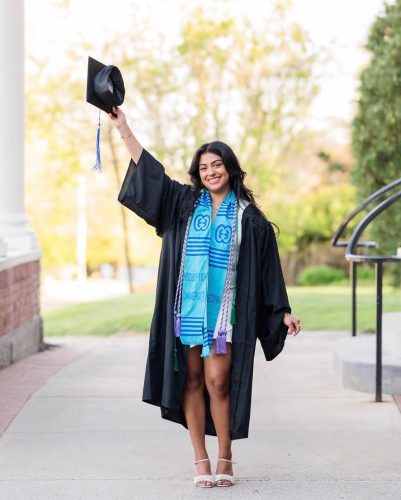
The Foundation honored Gammons the only way it knew how — by putting his name on something that would outlast all of them. The Peter Gammons College Scholarship. A program that, Paul says, has changed hundreds of young lives and continues to grow every year.
Closing the Gap
The scholarship, Paul is quick to explain, is not a one-time check. It is not a pat on the back and a good luck. It is a four-year recurring grant, specifically designed to address something that too many financial aid conversations gloss over: the gap.
“Some kids are accepted at their college of their choice,” Paul says. “They have financial aid. But there’s still a gap — between what the financial aid covers and what the school actually costs. That gap stops kids. The Gammons Scholarship closes it.”
And then it goes a step further. Every scholar enrolled in the program gets a mentor. Not a randomly assigned one. A carefully, specifically curated mentor matched directly to that student’s interests and aspirations.
“A lot of scholarship programs just give the money,” Paul says. “We also give a mentor.”
The Foundation’s roots in Boston are personal in ways that go beyond the scholarship. Paul and Theo didn’t grow up in a bubble. They grew up in Brookline, attending the West End House Boys and Girls Club — the same organization that is now one of FTBNL’s core beneficiaries. “There’s a deep personal connection,” Paul says. “A history. We attended that Boys and Girls Club. We know what it meant to us. We know what it means to the kids there now.”
That thread of personal investment runs through everything the Foundation does. They don’t cut checks to organizations they’ve only read about in annual reports. They know the people running them. In many cases, they grew up alongside them.
The Secret Sauce
Ask Paul Epstein what makes Hot Stove Cool Music work after all these years, and he doesn’t hesitate.
“The crossover,” he says. “That’s the secret sauce.”
It sounds simple. It isn’t. What HSCM has managed to do — year after year, in a city that is notoriously protective of its institutions and suspicious of anything that smells manufactured — is create a genuine intersection between two worlds that have always secretly wanted to be each other.
Baseball players who want to be rock stars. Rock stars who grew up wanting to play ball. Lenny DiNardo pitched for the Red Sox and never went on a road trip without his guitar. Bronson Arroyo had pipes and wasn’t shy about using them. Eddie Vedder — Pearl Jam’s Eddie Vedder — takes batting practice at Fenway Park every time the band comes through Boston. His relationship with Theo goes back years, and it shows every time he steps on the HSCM stage.
“It’s a total crossover appeal,” Paul says. “These worlds genuinely want to be together. You can feel it in the room.”
And the room matters. The Paradise on Commonwealth Avenue has hosted the vast majority of HSCM shows over the past 26 years. Occasionally the event moves — Fenway itself, the House of Blues — but it always comes back to 967 Commonwealth. The room holds the history. The walls know the setlists.
This Year’s Show
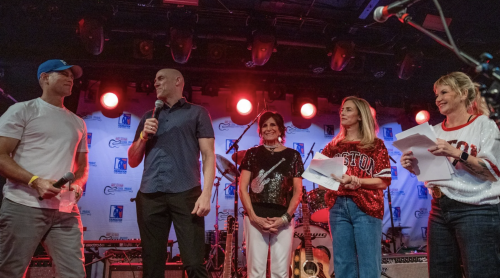
The 2026 edition delivered exactly what the faithful have come to expect: a lineup that somehow keeps getting better, an energy that doesn’t feel like a charity event, and at least one moment that could only happen in Boston.
Fountains of Wayne headlined — “not just Stacy’s Mom, but all the other hits too,” Paul promises — joined by the perennial Hot Stove All-Stars, the rotating cast of Boston musicians and celebrities who have made HSCM their annual homecoming. Kay Hanley. Will Dailey. Wyc Grousbeck, who takes the stage with his band French Lick and, Paul notes, looks like a completely different person the moment he starts playing. “Just this smile on his face. Like, this is the real him.”
And then there is Bernie Williams. Hall of Fame center fielder. Five-time All-Star. World Series champion four times over with the Yankees — a fact that Boston fans have long since learned to set aside in the spirit of the evening. And, depending on who you ask, a Grammy winner.
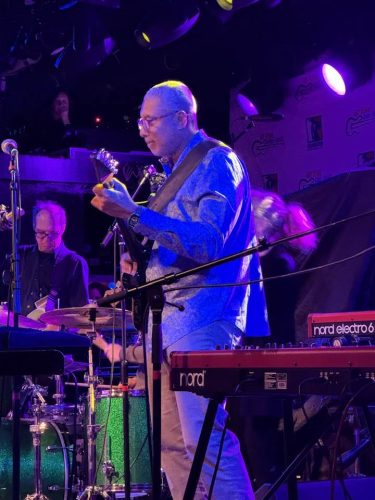
“He may well have won,” Paul says carefully. “We have to research. Fact check it.”
As for Theo — who has been playing guitar on the HSCM stage since that third show back in 2003, when he showed up with his band Trauser just weeks after being named GM — Paul has a story he has clearly been waiting to tell.
“The joke for years,” he says, “was that when he got up on stage and played, we didn’t even plug in his guitar. Because he doesn’t really know how to play that well.”
Theo may see this magazine before it goes to print. Paul Epstein is completely unbothered.
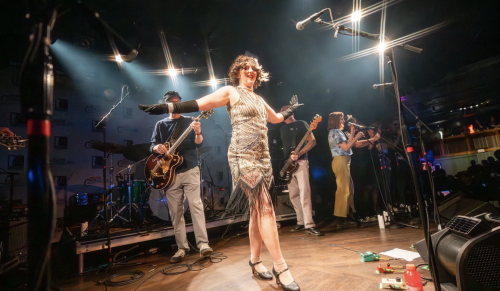
One Paradise. Every Year.
Twenty-six years. More than 250 acts. Hundreds of college scholarships. Two cities. Dozens of nonprofits. One room on Commonwealth Avenue that started all of it.
Hot Stove Cool Music is the kind of thing Boston produces when nobody is really trying to produce anything — when two brothers want to do some good, a Hall of Fame writer picks up a guitar he hasn’t touched since college, and a conversation in a crowded hallway becomes a reason to show up, every single January, for more than a quarter century.
The Foundation has expanded to Chicago. It has outlasted Theo’s tenure in both Boston and Chicago. It runs, Paul says, largely on the extraordinary energy of Executive Director Elise Najimi, who he describes as a one-woman show connected to virtually every athlete and charitable mind in the city.
But the engine — the real engine — is still the music. Still the Paradise. Still the room full of people who came for the show and stayed for something larger than they expected.
“Somehow,” Paul Epstein says, leaning back, “it just continues on.”
He says it like he’s still a little surprised. Like that November night in 2000, when a poster on a wall in a crowded hallway started all of this, is never quite as far away as the calendar says it is.
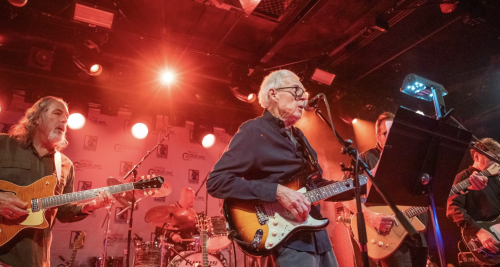
Hot Stove Cool Music benefits the Foundation To Be Named Later. Learn more at ftbnl.org. The Peter Gammons College Scholarship program accepts applications annually.