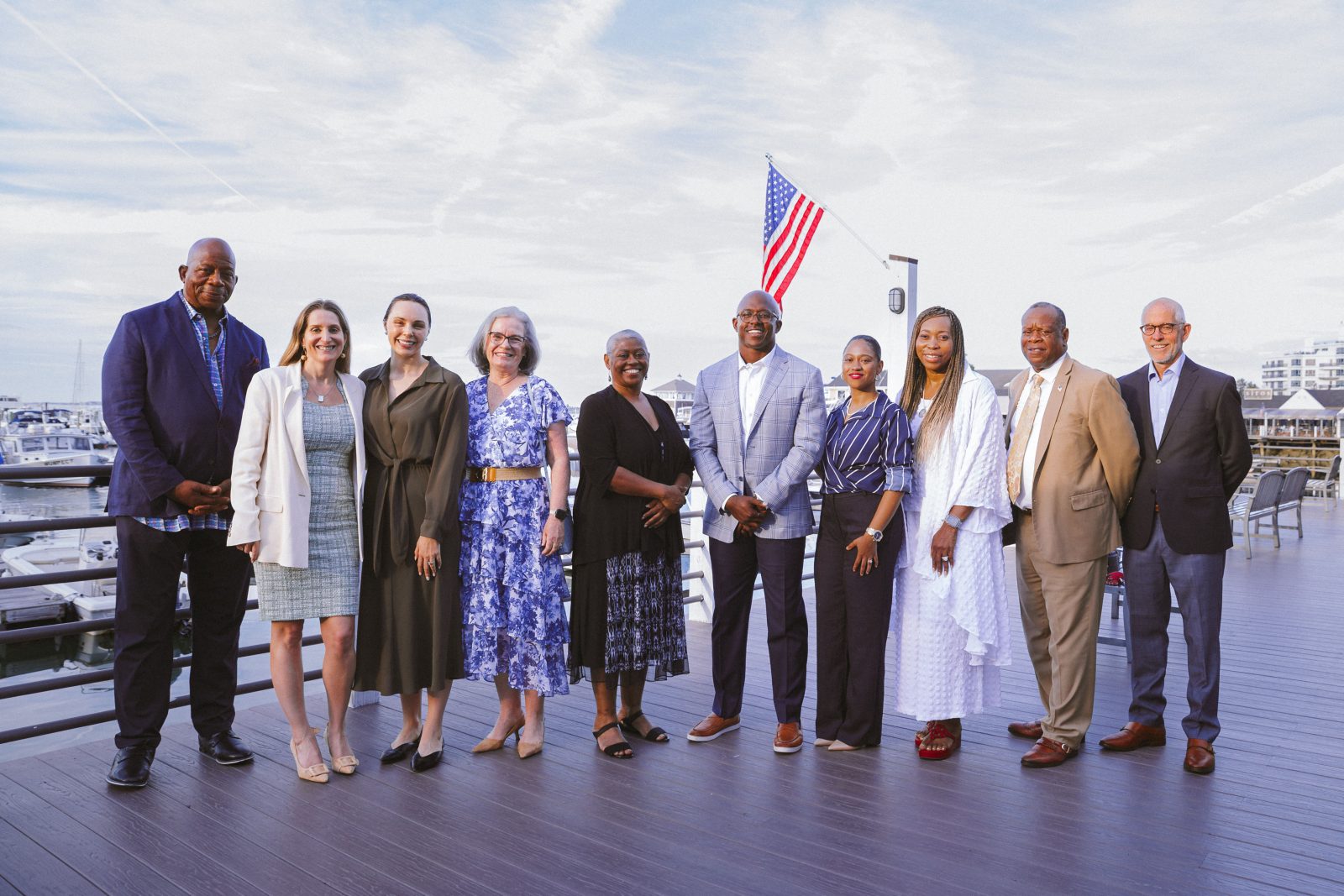

Thirty years after her 15-year-old son was killed in a Dorchester crossfire, Chaplain Clementina Chéry turned a mother’s grief into a national movement. Now a first-of-its-kind healing center is preparing to rise on Westville Street — and Boston has a chance to build it.
December 20, 1993 dawned gray and cold in Boston. An inch of snow had fallen the day before, and the forecasters were promising more coming up from the south, so the city was talking about a white Christmas. Fifteen-year-old Louis David Brown went to his classes at West Roxbury High like any other Monday. He had plans for the afternoon — a Christmas party thrown by Teens Against Gang Violence, a group he’d joined because peace was something he actually thought about.
He was, by every account, a remarkable kid. An honor student and a sophomore already talking about college, Louis loved to read, was drawn to engineering, and intended to earn a PhD. He told his family, more than once and without a trace of irony, that he planned to become the first Black president of the United States. He worried about the way people wrote off teenagers from his Dorchester neighborhood, and he believed that if real peace was ever going to happen, it would fall to his generation to make it — “regardless which side of the street they came from.”
He never made it to the party. Walking from his home toward the meeting, Louis stepped into the space between two groups of young men on the corner of Tonawanda Street and Geneva Avenue and was killed in the crossfire. He was 15.
What happened next — or rather, what didn’t — is the reason there is a Louis D. Brown Peace Institute at all. In 1993, Boston had no resources for the survivors of homicide victims. No one to call, no one to guide a family through the machinery of a sudden, violent death. Louis’s parents left the hospital, as the Institute’s own history puts it, “empty-handed and empty-hearted.” And when the media first speculated about why a teenager had been shot in broad daylight — Was he in a gang? A drug deal gone wrong? — and then discovered he was an honor student on his way to an anti-violence meeting, public sympathy poured in. For Louis’s family, the outpouring came wrapped in a hard question: if their son had carried a record instead of a report card, would anyone have shown up at all?
That question became a mission.

A Mother’s Answer
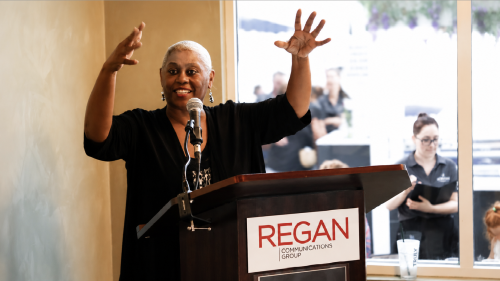
In 1994, Clementina Chéry co-founded the Louis D. Brown Peace Institute to honor her son and continue the work he’d started. It began with a curriculum — a way to teach young people the value of peace and to give them tools for handling murder, trauma, grief, and loss. The Peace Curriculum drew national attention: the U.S. Department of Justice cited it in a report on Boston’s juvenile crime reductions, singling it out as an innovative, effective prevention strategy.
But the deeper transformation was in how Boston treated grieving families. By 1996, the city and the Boston Police Department were referring survivors directly to Chéry, and she saw up close how families were quietly denied support and services when a loved one was “known to police” or carried a criminal history. She refused to accept the distinction. Every survivor, she insisted, deserved to be met with dignity and compassion, no matter the circumstances of the death — the exact principle her own family’s experience had thrown into such sharp relief. With the backing of the Boston Public Health Commission, she built Survivors Outreach Services to deliver consistent, coordinated support to impacted families.
Three decades on, that work has made the Peace Institute a national model. It is an integral partner to the City of Boston and to cities around the country that are trying to transform how society responds to homicide — not only for the families left behind, but for people returning from incarceration, for communities carrying the weight of repeated loss, and for young people determined to build something better.
Chéry has also pushed Boston to change the words it uses. When a news report last year branded Dorchester, Mattapan, and Roxbury the city’s “murder triangle,” she pushed back — not by denying the neighborhoods’ history with violence, but by refusing to let it stand as the whole story. These are places, she points out, where people hold down jobs, raise their kids, fill the pews on Sunday, and show up for one another in ways that rarely make the news. Her counter-name for that same geography: the Peace Triangle. It is a small rhetorical move with a large idea underneath it — that a neighborhood is defined by its capacity for healing, not only by its wounds.
What Peace Looks Like on a Sunday in May
If you want to see that idea in motion, you go to Town Field Park on Mother’s Day.
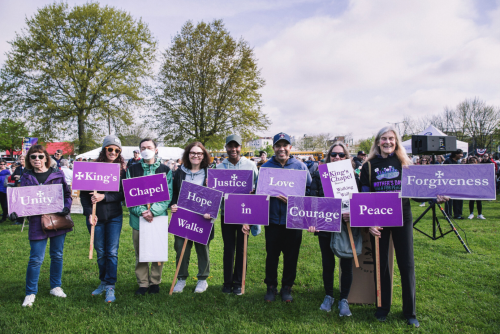
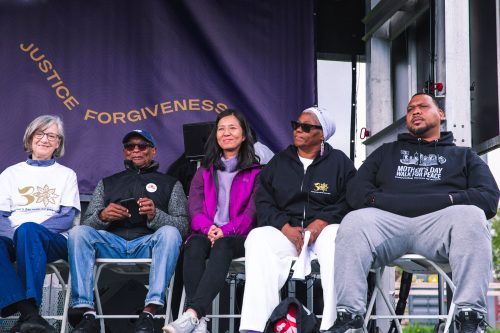
On May 10, 2026, more than 5,000 walkers gathered there for the 30th Annual Mother’s Day Walk for Peace, the Institute’s largest fundraiser and one of the most quietly powerful traditions in the city. This year’s theme, “30 Years Strong,” said the quiet part out loud: three decades of survivors, families, elected officials, and neighbors stepping off together through the streets of Dorchester to honor lives lost to violence and to fund the year of healing work ahead.
It is a fundraiser, and a serious one — this year’s walk pulled in nearly $500,000 toward a $600,000 goal the Institute set for itself by Father’s Day. But anyone who has been will tell you the Walk is not a somber affair. After the route, the crowd folds into a community rally and concert, this year with live music from Angelena and the Unit, mocktails, local food from vendors like Snacks Box Boston and Murl’s Kitchen, and small gifts for the mothers who form the beating heart of the whole thing. Across Massachusetts, landmarks lit their facades purple in a “Turn Massachusetts Purple” tribute to the families and communities the Institute serves.
“Seeing thousands of people come together to honor loved ones while investing in peace and healing is deeply powerful,” Chéry said of the milestone, “and reminds us why this work is so important.” Grief and joy, in other words, occupying the same field on the same afternoon. That is the Peace Institute’s entire theory of change, compressed into a single Sunday.
Champions for Peace
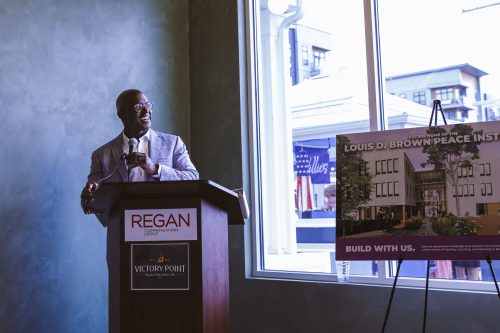
The work has a way of drawing in people who understand something about teams, pressure, and showing up for others. This summer, the Institute welcomed one of the most respected leaders in New England sports as the featured guest at “Champions for Peace,” an event held at Victory Point on the Quincy waterfront to rally supporters behind the next chapter of its mission.
Matthew Slater — the three-time Super Bowl champion, 10-time Pro Bowler, and 16-year New England Patriots special teams captain long regarded as the spiritual leader of the locker room — lent his platform to the cause. Now an assistant football coach for character and development at Boston College High School, Slater spoke about the human necessity of the kind of space the Institute is trying to build.
“People go through a lot, the human experience brings you a lot, and a lot of it is very hard,” he told the Boston Herald. “But to be able to have a space where you can come and try to heal and move forward from that, find common ground with the people you’re in community with, I think we need more spaces like this.” A place of refuge where people can lay their burdens down, he added, is “going to be a beacon of hope.”
That “space” is no longer a metaphor. It has an address.
Infrastructure for Peace
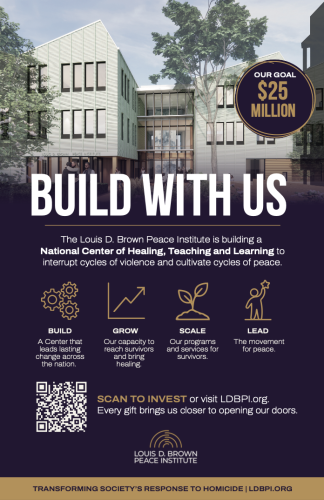
At 30 Westville Street, in the Four Corners section of Dorchester, the Peace Institute is preparing to build the National Center of Healing, Teaching, and Learning — a 19,000-square-foot home that its own leaders describe, pointedly, in terms bigger than a building. “The Center is not just a building,” the campaign materials read. “It’s infrastructure for peace.”
Designed with trauma-informed intention by an accomplished team including Utile and MASS Design Group, the Center reads less like an office and more like a carefully sequenced experience of arrival and decompression. Visitors move through an entry garden — “a pathway to decompression,” as the plans put it — into a healing garden built as a place to meet, learn, and heal. Inside, the first floor is organized around gathering: a soaring lobby, a community room that opens to the garden, an art room, a chapel, and the John Ramsey Peace Café. At its heart sits Louis’ Room, an exhibition hall named for the boy who started it all.
Climb higher and the building shifts from healing to teaching and telling. The second floor holds the Learning Center, home to the Institute’s “peace curricula,” alongside intimate family meeting rooms designed as private, comfortable spaces for the hardest conversations — plus a media lab, podcasting suite, and a full video recording studio built to broadcast the message of peace far beyond Boston. There are rooms with names that tell you exactly who they’re for: a Peace Clubhouse, a Nana’s Den. The top floor houses the working hum of the organization itself — open workspace, a conference room, a mini makerspace for turning advocacy into something you can hold. Built by and for survivors, the Center is engineered to reach well beyond the city, teaching other communities what the Institute has learned about homicide response, violence prevention, and peacebuilding. Its construction alone will bring jobs and opportunity to the neighborhood; once open, it becomes a permanent economic and civic anchor in a community that has too often been handed the opposite.
The Path & The Moment
None of this happened quickly. The Institute has been chasing a permanent home for more than 20 years, through conversations that began with the late Mayor Thomas Menino and continued across the Walsh, Janey, and Wu administrations. In late 2019, then–City Councilor Andrea Campbell — now the Massachusetts Attorney General — identified 30 Westville Street, a vacant, city-owned lot, as the right piece of ground. After community meetings in 2020, the Institute was officially designated to build there in March 2023. Construction documents are complete. The project is, in the industry’s parlance, shovel-ready.
What stands between the drawings and the doors is money — and here the moment is unusually ripe. The Campaign for Peace, a $25 million capital initiative, has already secured $8.5 million in commitments from a roster of “Peacevestors” that includes the Commonwealth of Massachusetts, the City of Boston, federal HUD funds, and heavyweight philanthropy from the Klarman Family Foundation’s Community Capital Fund, the Richard and Susan Smith Family Foundation, the Josephine and Louise Crane Foundation, Eastern Bank Foundation, and State Street Foundation. A rare “double round” of federal New Markets Tax Credits in 2026 could layer on several million more, positioning the Institute to raise the roughly $7.5 million in fresh commitments it needs to break ground this year.
“Our community is ready,” the campaign puts it plainly. “Our building development team is ready. Philanthropy and investment are needed to seize the moment.”
The Dream, Still Standing
There is a detail in all of this that’s easy to miss. The younger cousin who once wrote about Louis — remembering “a young boy whose joy filled every room,” the way he moved through the world “with laughter, confidence, and curiosity” — is Luis Antonio Thompson. Today he answers the phone as a member of the Peace Institute’s staff. The dream didn’t die on that corner in 1993. It got a family, an organization, a curriculum, a Mother’s Day tradition 5,000 people strong, and now, if Boston chooses to build it, a permanent home.
Louis wanted to bring peace to his city and believed his generation would be the one to do it. He didn’t get the chance. His mother spent the last 30 years making sure the chance survived him — turning the worst day of her life into the kind of infrastructure a city can lean on long after any of us are gone. The invitation on the final page of the Institute’s plans is only three words, and after everything, they land like a challenge worth answering.
Build with us.