
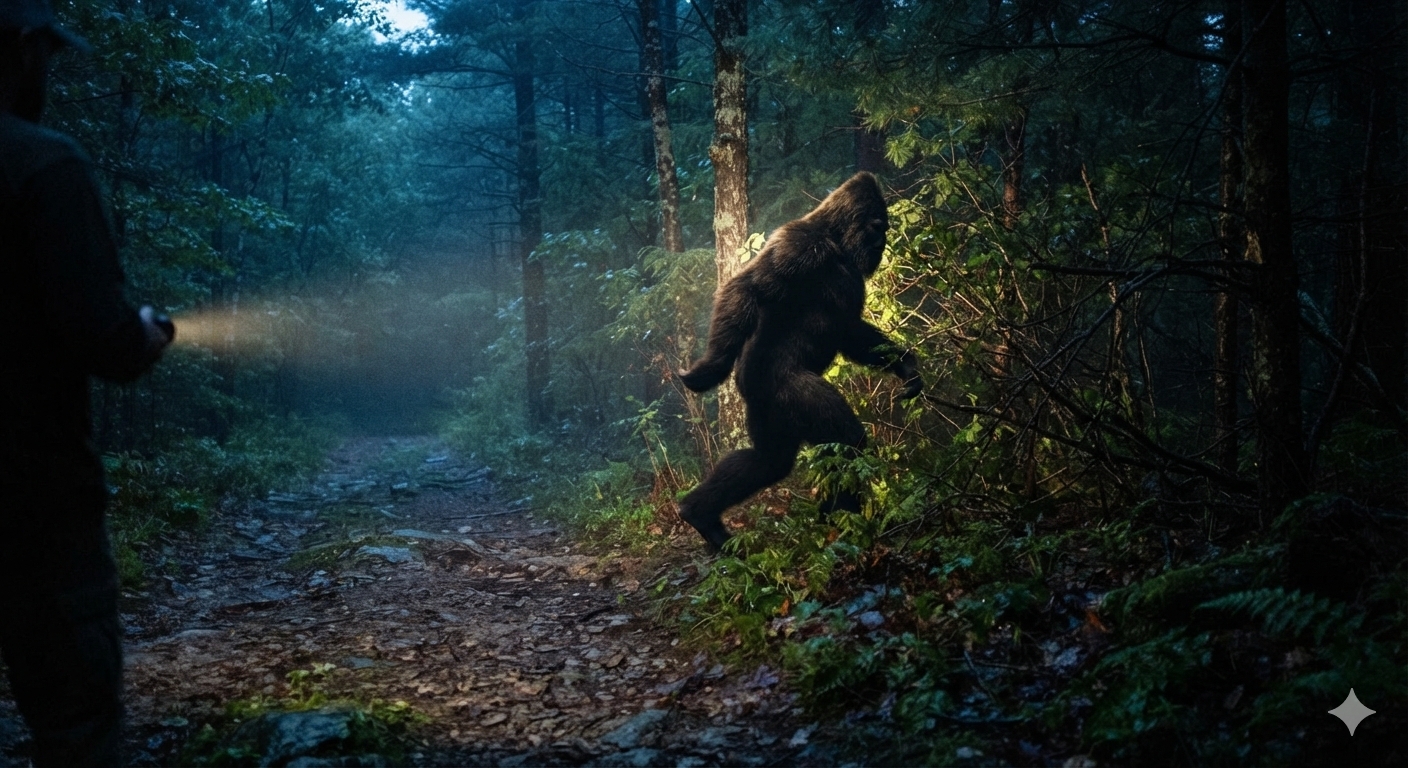


VOLUNTOWN, CT — The early hours of July 5, 2026, were much like any other midsummer night in New England: thick with humidity, quiet, and pitch-black. But along a lonely stretch of Wiley School Road, just a few hundred feet west of Forge Hill Road, the ordinary dissolved into the impossible.
It was here that an unnamed eyewitness came face-to-face with a massive, dark figure moving at an astonishing speed through the brush bordering the Pachaug State Forest.
While cryptid rumors are nothing new to the internet, this particular encounter has sent shockwaves through the regional tracking community. The Bigfoot Field Researchers Organization (BFRO), a group dedicated to documenting encounters with the elusive creature, recently analyzed the eyewitness testimony and granted it their highest level of credibility. According to investigators, the sheer level of detail provided by the witness sets this event apart from the typical blurry photographs and ambiguous campfire tales.
Why Investigators are Listening
What elevates this sighting from a midnight hallucination to a credible entry in the BFRO database is the precise anatomical and behavioral data provided by the witness. Unlike vague accounts of “something dark in the trees,” the observer noted a distinct, fluid locomotion known as a compliant gait—a heel-to-toe stride where the knees remain bent, a characteristic notoriously difficult for a human in a suit to replicate over rough terrain.
Furthermore, follow-up investigations at the Wiley School Road site revealed compelling physical evidence. Searchers documented atypical structural damage in the undergrowth, including heavy tree branches snapped at a height of nearly eight feet—well above the reach of local black bears. Ground impressions, though degraded by summer rain, indicated an immense weight shifting across the soft forest floor, pressing deep past the top layer of leaf litter.
The Perfect Biomass Sanctuary
It shouldn’t come as a total surprise that if a Sasquatch were to make a home in southern New England, it would choose Pachaug. Spanning more than 26,000 acres of dense, rugged woodland, stagnant swamps, and remote, winding trails, it is Connecticut’s largest state forest. But it isn’t just the sheer size that matches the ideal parameters for a large, undocumented primate—it is the resource-dense ecosystem.
Pachaug functions as a massive, contiguous wildlife corridor that bleeds directly into western Rhode Island.
This connectivity allows an animal to travel dozens of miles without ever crossing a major highway or encountering a suburban neighborhood. The forest is also a thriving biomass hub, boasting a massive population of white-tailed deer, wild turkeys, and seasonal foraging options like wild berries and freshwater fish from its many ponds and streams.
“Every once in a while, if it’s really quiet and still, you’ll hear a branch pop in the distance,” says Richard Fedor, a local resident who has spent decades living near the edge of the forest. “We have black bears, raccoons, bobcats—that sort of thing. So it wouldn’t entirely surprise me if there’s a Bigfoot out there too. The food and cover are definitely there.”
_______________________________________________________________________
The Hiker’s Guide to a Cryptid Encounter: Do’s and Don’ts
If you find yourself deep in the New England timber and suspect an undocumented giant is nearby, standard wildlife protocols change. Keep this emergency checklist in mind:
🟢 WHAT TO DO
Maintain Your Distance: Treat a potential Sasquatch like any unidentified apex predator. Give the creature a minimum of 100 yards of space to avoid triggering a defensive territory response.
Document the Environment: Look down, not just ahead. If you suspect an encounter, immediately take photos of the ground for fresh tracks. Place a standard object (like a water bottle or foot) next to the print for a clear size scale.
Note the Acoustic Markers: Listen for heavy, rhythmic wood-knocking sounds or deep, low-frequency vocalizations. Note the exact time, duration, and direction of the sounds.
Leave the Area Calmly: Walk backward slowly while keeping your eyes on the tree line. Keep your movements predictable and non-threatening.
🔴 WHAT NOT TO DO
DO NOT Pursue or Track: Never attempt to follow a fleeing creature into dense brush. Large primates are immensely powerful, and pushing into their blind spots creates high-risk confrontation zones.
DO NOT Flash Bright Lights: Avoid shining high-lumen tactical flashlights directly into the eyes of the animal. Intense light can startle it, transforming a passive observation into an aggressive charge.
DO NOT Throw Objects: Resist the urge to toss rocks or branches to get a reaction. In primate behavior, throwing objects is an escalation tactic—and they throw back with lethal force.
DO NOT Use Artificial Scents: Avoid using heavy perfumes, chemical pheromones, or thermal bait stations if you are an amateur tracker. These often draw curious black bears instead, creating immediate, real-world danger.
_______________________________________________________________________
The New England Corridor: A Shared History
The Pachaug incident may be dominating recent headlines, but it is merely the latest chapter in a long, regional history of sightings. While critics treat New England as a tightly packed cluster of suburbs, cryptid researchers view the region as a massive, connected wilderness shield.
According to cumulative BFRO data, the surrounding states possess their own deeply entrenched Sasquatch lore:
Massachusetts (39 Sightings): The Bay State leads the region in total reports. The epicenter is October Mountainin the Berkshires, along with a dense tract of the Leominster State Forest locally dubbed “Monsterland.” Reports here date as far back as the late 1800s, with a recent spike in activity reported as recently as May.
Rhode Island (5 Sightings): The Ocean State might be small, but its western border is heavily forested and shares a direct ecological link to the Pachaug ecosystem. The Arcadia Management Area in Exeter and the rural woods of Foster have both been the sites of distinct encounters, where witnesses reported massive bipedal figures crossing dark backroads under the cover of night.
Vermont (11 Sightings): The Green Mountain State boasts a historic cluster of activity. The wilderness stretching from the Harriman Reservoir up toward Lake Champlain has yielded multiple accounts, with the state’s most recent official filing logged in 2019.
New Hampshire: Deep in the Granite State woods, independent trackers like “Hiker Dave” document odd environmental markers. In towns like Gilmanton, researchers have recorded strange audio anomalies known as “tree knocks” and captured footage of dark objects tracking deep within the thick tree lines.
Maine: The rural forests bridging the gap between Durham and Woolwich have consistently exhibited Sasquatch activity over the last 40 years, fueled by the state’s sprawling, uninterrupted canopy that links directly into vast Canadian territories.
A Town Divided
Yet, not everyone in Voluntown is ready to buy into the legend. In a town where quiet backroads are prized, the sudden influx of curiosity seekers has drawn a mix of amusement and skepticism.
“You know, it’s probably just a guy running around in a costume,” laughs neighbor Peter Gautieri, expressing a sentiment shared by many locals. Skeptics point out that in an era dominated by high-resolution smartphones and pervasive trail cams, an eight-foot-tall primate escaping definitive detection nationwide seems mathematically improbable. Others attribute the late-night sighting to the tricks the mind can play when influenced by exhaustion, dehydration, or the shifting shadows of the New England canopy.
A Growing Legend
Despite the doubts, the July 5th incident marks the 22nd reported Bigfoot sighting in Connecticut, according to the BFRO’s historical data. For investigators like Mike Young, who interviewed the witness just days after the encounter, the Pachaug incident represents a compelling piece of a much larger regional puzzle.
As autumn approaches and the leaves begin to drop, the dense canopy of Pachaug will thin, offering better visibility—and perhaps more anxiety—for those who walk its trails after dark. For now, the woods of Voluntown hold their secrets tight, leaving hikers to glance just a bit more frequently into the shadows, wondering exactly what is walking around back there.