
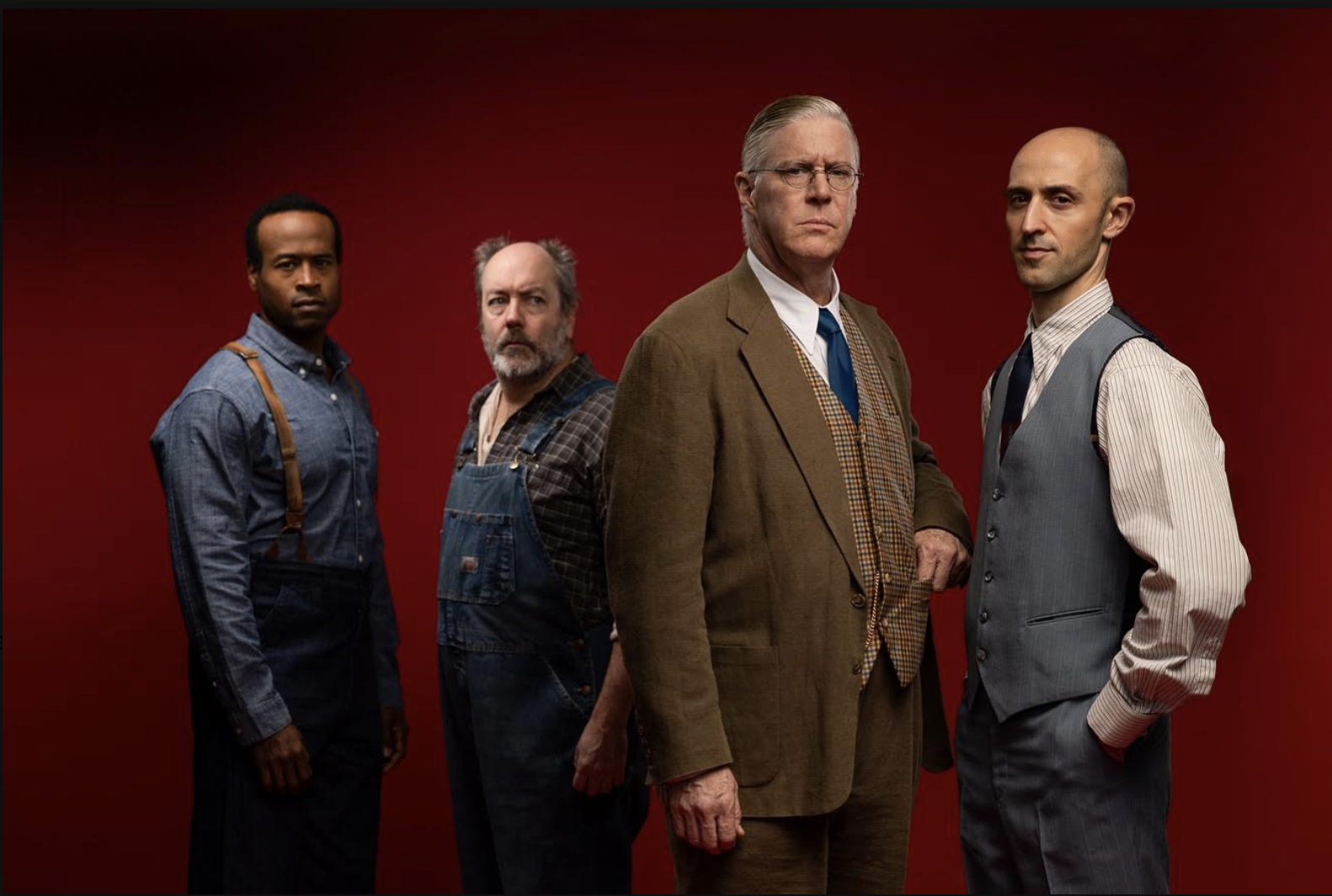

The Huntington’s Mockingbird Asks If Goodness Is Enough
___________
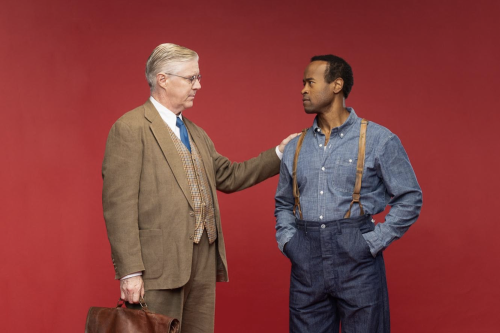
ONE-LINE VERDICT: Sorkin’s Mockingbird stops asking whether Atticus Finch is a good man and asks whether being a good man is ever enough. The Huntington’s answer, delivered in a silence you could hear a pin drop in, is hope.
The review
I walked out of The Huntington on a Sunday afternoon with one word in my head: hope. That surprised me, because the hours before it were some of the most uncomfortable I’ve spent in a theater this year.
The racism in Aaron Sorkin’s adaptation of To Kill a Mockingbird isn’t scenery. It sits in the room with you, in the slurs, in the smirks, in the casual way decent townspeople shrug it off. Loretta Greco’s production, the first by a regional theater since the play left Broadway, doesn’t let the audience off the hook for a second.
Midway through, a minor character named Link Deas warns the Finch children that they’ll get used to cruelty, that they’ll build up a tolerance. Then he delivers the line that stayed with me all the way home: “When horror comes to supper, it comes dressed exactly like a Christian.” That’s the play in a sentence. The danger isn’t the monster at the edge of town. It’s the neighbor at your table.
Most of us know this story from a high school reading list or Gregory Peck’s white suit. Sorkin bets that knowing it is exactly the problem. We’ve been taught to admire it from a safe distance.
He wants us closer.
Not your English-class Mockingbird
The official title is Harper Lee’s To Kill a Mockingbird, a reminder of the legal fight Lee’s estate waged over how far Sorkin strayed from the book. The case settled. The argument didn’t. Make no mistake: this is Sorkin’s Mockingbird, and the differences are the whole conversation.
Lee’s novel is Scout’s coming-of-age story, told as she looks back on her childhood. Sorkin splits the narration among all three kids, Scout, her brother Jem and their summer friend Dill, and moves Atticus to the center. He scrambles the timeline too, cutting between the courtroom and the Finch porch, and trims the Boo Radley adventures that fill the first half of the book. What’s left moves like a courtroom drama, which is what Sorkin has always done best.
The biggest change is Atticus himself. In the novel and in Peck’s Oscar-winning performance, he is close to a saint. Sorkin keeps the decency but turns his signature virtue, his insistence on seeing the good in everyone, into his blind spot. Sorkin has said he didn’t have to invent that flaw. It was always in the book. We were just taught to read it as a virtue.
So this Atticus keeps extending the benefit of the doubt to people who have long since forfeited it, including the man determined to see an innocent man put to death. His son pushes back. Jem wants to fight, and Atticus answers that violence and strength are not the same thing. The play lets both of them be partly right, and that tension is where it comes alive.
Sorkin also set out to give the story’s two central Black characters, Calpurnia and Tom Robinson, a voice the novel largely denied them. On paper, it’s the most important fix he made. On stage, as I’ll get to, it’s only half finished.
The performances
The moment I’ll remember is Jackie Scholl as Mayella Ewell on the witness stand. The house went so quiet you could hear a pin drop. Scholl plays her as a young woman coming apart in real time, twitching between terror and fury, and you understand long before the verdict that the truth of what happened in that house is far uglier than the lie she’s been coached to tell. It is devastating, and every glowing word written about her is earned.
The trial scenes are the production’s spine. Jesse Garlick’s prosecutor needles Tom Robinson about why he’d help Mayella with chores for nothing, a question that pretends a Black man in 1930s Alabama could simply say no to a white woman. Rafael Jordan answers with a quiet, wounded dignity that makes the cruelty of the question land even harder. Ken Cheeseman’s judge presides with weary impatience, and Liam Craig makes Bob Ewell genuinely frightening without tipping into cartoon.
I was skeptical about adults playing the children. It took a few minutes, but Karen Killeen’s Scout, all elbows and stubborn curiosity, pulls you in, and her co-stars as Jem and Dill follow. By the trial, I’d stopped noticing their ages and started seeing the story through their eyes, which is exactly the point.
Karl Kenzler’s Atticus is not Gregory Peck, and he isn’t trying to be. On the page, we see Atticus through his daughter’s adoring eyes. On stage, that filter is gone, and his flaws read differently: less tragic nobility, more a decent man who is slow to see what’s in front of him. It’s a less comfortable Atticus, and a more honest one.
My one real disappointment is Calpurnia. Sorkin has been praised for giving her a voice, and Patrice Jean-Baptiste is a commanding actor. But too often the script sidelines her, or plays her pushback against Atticus as passive-aggressive comic relief. Instead of a moral counterweight, she becomes a punchline, and that lessens the play.
Greco’s staging does its best work in the details. A towering tree draped in Spanish moss hangs over the entire play, a silent witness that never needs to be explained to be menacing. When the lynch mob comes for Tom, its hooded men stalk down the theater’s own aisles, putting the audience inside the threat before Scout disarms it by recognizing one of them. And musician Ashley Frith drifts through the scenes, unseen by the characters, scoring the story live like a conscience no one in Maycomb can hear.
Why it lands in Boston, now
My Sunday matinee skewed older, a crowd that likely read the novel in school and grew up with Peck’s Atticus as the gold standard of American decency. Watching that audience sit with Sorkin’s tougher, more doubtful version was its own kind of theater. That discomfort is the point.
One phrase hit harder than anything else: “All rise.” In 1935 Maycomb, it’s a courtroom formality.
In 2026, it plays like a summons to everyone in the seats. The play makes clear that the verdict doesn’t belong only to the twelve men in the jury box. It belongs to a whole town that decided, long before the trial, what it was willing to believe.
What struck me most is how little the geography matters. Bostonians have long found it comfortable to treat Mockingbird as a Southern story, something that happened somewhere else, to someone else. Sorkin’s version quietly takes that comfort away. Strip out the drawls and the Spanish moss, and Maycomb could be any town where decent people look away.
This city knows that story firsthand. In 1989, Boston was ready to believe a white man’s lie that a Black stranger had shot his pregnant wife, and police descended on Mission Hill before the truth came out. Thirty-seven years later, a play about a false accusation in a small Alabama town doesn’t feel like a period piece. It feels like a mirror.
Some have called a classic an unadventurous choice for The Huntington. I disagree. A story everyone thinks they already know is exactly the right vehicle for asking what we still haven’t learned. The familiarity is the trap, and this production springs it.
The verdict
This isn’t a flawless production. Calpurnia deserves far more than the script gives her, and purists will bristle at Sorkin’s liberties with a book they love. But it’s a bold, moving take on an American classic, and it trusts its audience to sit with discomfort rather than handing them a hero to hide behind.
Which brings me back to hope. It doesn’t come from the verdict, which is as cruel as it has ever been. It comes from the children, who refuse to build up the tolerance for cruelty the adults around them have made peace with. Sorkin’s Atticus learns, too late for Tom, that goodness isn’t something you can simply assume in your neighbors. Scout leaves the play understanding it’s something you have to demand.
Lee’s novel asked whether one good man could stand against a town. Sorkin’s play asks whether a good man can see what his town really is. That question doesn’t belong to Alabama, or to 1935. It belongs to Boston, and to all of us. See it before it goes.
Production details
| Show | Harper Lee’s To Kill a Mockingbird, adapted by Aaron Sorkin |
| Director | Loretta Greco |
| Venue | The Huntington Theatre, 264 Huntington Ave., Boston |
| Run | Through Nov. 8, 2026 |
| Tickets | From $29 at huntingtontheatre.org |
