

Forty years before the shadows fell across The Rocket’s Red Sox at Shea Stadium in October 1986, a similarly gifted, similarly haunted Boston ball club led by The Splendid Splinter chased the same elusive autumn glory, only to find the same exquisite heartbreak waiting for them at the end of 1946’s line.
_________
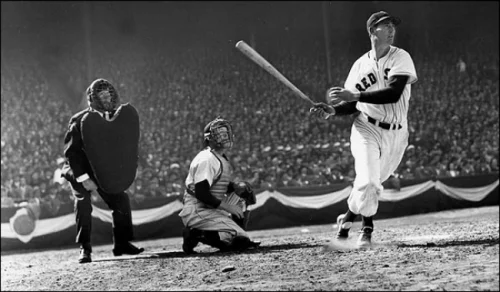
THE CLOCK of a baseball fan does not move in standard solar cycles; it measures time in the long, looping arcs of memory and the generational inheritance of grief.
All through New England this year, a quiet, collective remembering has taken hold. We are marking the forty-year boundary since the autumn of 1986, a season when a band of complicated, brilliant men—Clemens, Rice, Boggs, and the rest—carried a region to the very lip of the mountain, only to watch the earth give way beneath their spikes.
Here at BostonMan Magazine, in our spring pages, Peter Gammons evoked that beautiful, agonizing era with a mastery that felt less like sports journalism and more like a seance, capturing the raw, unvarnished grace of a team that stood one pitch away from forever.
Yet, if you look closely at the math of New England’s sporting soul, you discover a strange, recurring rhythm. Forty years before Bill Buckner stood anchored to the grass in Queens, an identical heartbreak befell our grandfathers.
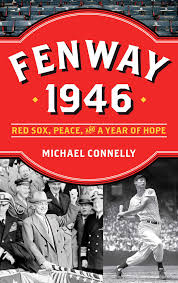
Eighty years ago, in the bittersweet summer of 1946, another Red Sox team dominated the American landscape, captured a city’s affection, and broke a million hearts with a suddenness that still echoes when the wind blows hard through the grandstands of Fenway Park. To understand the team of 1946 is to look into a mirror of 1986. It is to witness the exact moment that American sports, and the fragile, post-war nation itself, came roaring back to life.
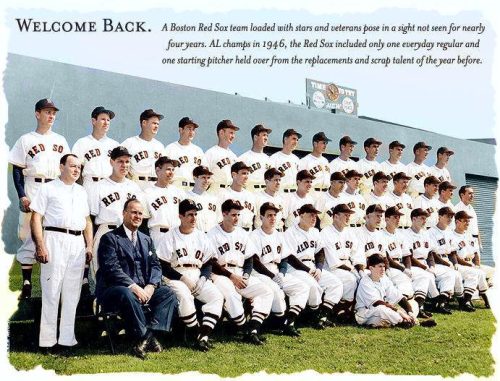
Flannels, Freedom, and a New Frontier
In the spring of 1946, America was a country rubbing its eyes, waking up from the long, ash-colored nightmare of global war. The home front was uncoiling. The heavy factories were quieting their munitions lines, and the rationing books were being tossed into attic trunks.
While John William Mauchly was busy in a university basement unveiling the ENIAC—the world’s first thirty-ton electronic digital computer utilizing nineteen thousand vacuum tubes for the Army—and Dr. Benjamin Spock was rewriting the American household with The Common Sense Book of Baby and Child Care, millions of young men were stepping off troopships, discarding their olive-drab wools, and looking for some tangible proof that the world they had saved was still waiting for them.
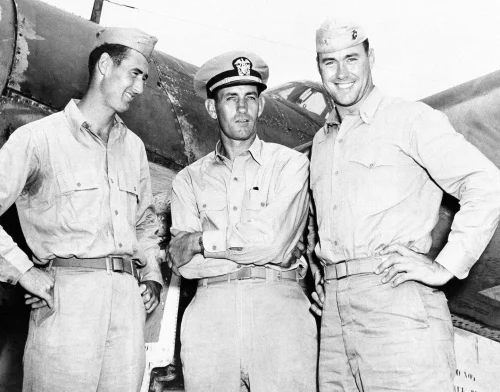
They found that proof on the green grass of the ballparks. For three long years, the major leagues had been a ghost version of themselves, populated by teenagers, aging journeymen, and those deemed unfit for service.
A year earlier, men like Snuffy Stirnweiss of the Yankees had played like MVP-caliber titans against inferior talent, only to degenerate back into common, .251-hitting ballplayers the moment the true giants returned.
The NFL was still an insular, regional curiosity, and the corporate colossus of modern basketball was months away from even playing its first primitive games.
But in 1946, baseball felt completely, magnificently whole again. More than three hundred major league veterans returned to the diamond.
The turnstiles groaned under the weight of a sports-starved public; national attendance nearly doubled its previous record, as five franchises eclipsed the one-million mark for the very first time.
In New York, the three big-league ballclubs attracted a staggering 5.3 million fans, with the Yankees making history as the first franchise ever to draw over two million souls.
They capitalized on the modern luxury of a leased United Airlines plane they called the “Yankee Mainliner”—even if traditionalists like old Red Ruffing preferred the steady, grounding clatter of the train tracks.
Yet, this sudden rush of peacetime prosperity brought its own corporate anxieties and friction. Below the border, a wealthy Mexican tycoon named Jorge Pasquel barged into the States loaded with bags of money, attempting to raid Major League rosters for his breakaway Mexican League.
Some twenty players jumped ship for tax-free salaries, including Danny Gardella and pitcher Max Lanier, while others performed an abrupt about-face when Commissioner Happy Chandler threatened a strict five-year banishment from American baseball.
Even Ted Williams was reportedly tempted by Pasquel with a kingly $500,000 offer, but “The Kid” chose to stay home, where the real theater was waiting.
Meanwhile, players back home sought their own security, forming the short-lived American Baseball Guild union under attorney Robert Murphy. They fought for a $5,000 minimum salary and full medical coverage, even threatening a walkout in Pittsburgh that failed to gain a required two-thirds majority.
The owners eventually conceded the terms, but the ballplayers, thrilled just to have their pre-war lives back, were largely too nervous about rocking the boat to sustain it.
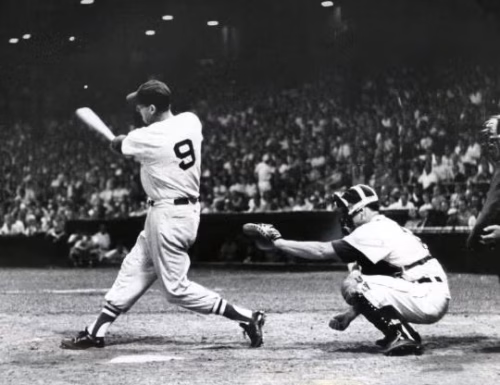
A Tale of Two Hub Franchises
Nowhere was the hunger deeper than in Boston, a city that still enjoyed the double-edged blessing of being a two-team baseball town.
On Commonwealth Avenue, the National League’s Boston Braves held court at Braves Field, managed by the brilliant Billy Southworth, whom the ownership syndicate had successfully lured away from the St. Louis Cardinals.
The ’46 Braves played a tough, highly respectable brand of ball, finishing fourth in the National League with an 81-72 record and drawing a franchise-record 940,000 fans of their own.
But across town, inside the royal-blue shadows of Fenway Park, Tom Yawkey’s Red Sox were assembling a juggernaut that would render the Braves a mere footnote in the battle for New England’s heart.
After thirteen years of patient, wealthy stewardship by Yawkey—who had rescued the franchise from the post-Harry Frazee depths of the depression—the Red Sox had been rebuilt into a modern, competitive club rich in distinct character and devastating hitting.
In 1946, Bostonians responded by doubling their previous gate to 1.4 million fans, packed into the wooden grandstands to watch a masterpiece unfold.
The Regular Season Juggernaut
The core of that Red Sox team was a fraternity of returned veterans who had traded their finest athletic years for service in the Navy and the Marines.
There was Johnny Pesky, sharp-eyed, relentless, and lightning-fast; Bobby Doerr, quiet, powerful, and steady as a grandfather clock; and Dom DiMaggio, the elegant center fielder who glided across the grass with a scholarly, bespectacled precision. And then, commanding the sun itself, was Ted Williams.
At twenty-seven, his body hardened by years of piloting Marine fighter planes, Williams returned to the batter’s box without the slightest hint of rust. He did not merely hit; he tyrannized the American League, en route to a .342 average, 38 home runs, 123 RBIs, and an astronomical .497 on-base percentage.
He rightfully walked away with his first American League Most Valuable Player award—an honor sportswriters had contextually robbed him of twice before.
Under the watchful eye of manager Joe Cronin, the Red Sox exploded out of the gate, rattling off a spectacular 15-game winning streak in April and May -a franchise record that stood alone for 80 years until Chad Tracy’s squad poetically matched it this summer.
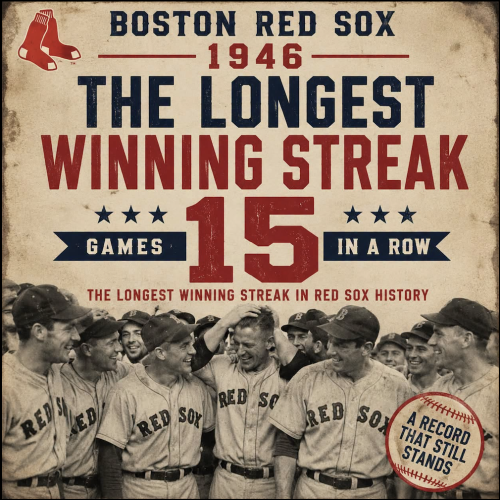
On May 8, during a 14-10 triumph over the White Sox, Johnny Pesky became the first American League player to single-handedly score six runs in a single game, pacing an infield that led the league with a .271 team batting average. Pesky hit everything thrown his way, leading the majors with 208 hits, while Doerr provided the cleanup thunder with 116 RBIs.
Alongside them stood first baseman Rudy York, a mid-season acquisition from Detroit known for white-hot batting rampages; on July 27, York belted two grand slams and drove in ten runs in a single afternoon against the Browns.
This relentless offense made life sweet for a dominant pitching staff. Second-year hurler Dave “Boo” Ferriss cruised to a magnificent 25-6 record and a league-leading .806 winning percentage. Veteran Tex Hughson added 20 wins of his own, while reliever Bob Klinger slammed the door out of the bullpen with a league-high 9 saves.
Boston ran away with the pennant, finishing with a breathtaking 104-50 record, leaving the hated Yankees seventeen games behind in third place. On July 9, Fenway hosted an All-Star Game that felt less like an exhibition and more like a victory gala, highlighted by Williams launching two home runs—including one off a legendary Rip Sewell “eephus” pitch—in a 12-0 American League rout.
The Great Gathering of Giants
To look at the baseball landscape in the summer of 1946 is to look at a canvas crowded with immortal brushstrokes. The game was no longer an island of replacements; it had become an epic theater where the greatest players of a generation gathered to reclaim their kingdom.
Far from the grand marble entryways of the major leagues, in the minor league outposts of the International League, the most important season in American history was quietly unfolding. In Montreal, a young, thick-shouldered shortstop named Jackie Robinson was wearing the uniform of the Royals.
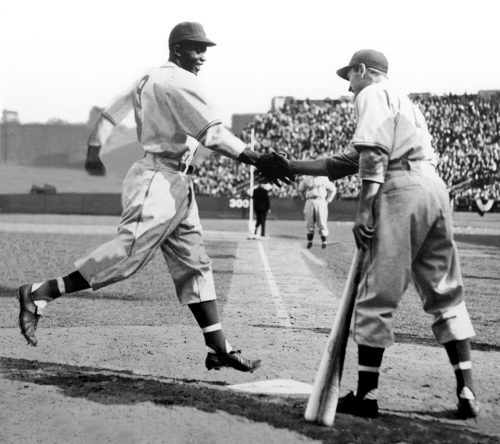
He was Branch Rickey’s grand, courageous experiment, playing under an unimaginable weight of prejudice, isolated hotel rooms, and flying spikes. Robinson did not merely survive; he conquered, batting a spectacular .349, stealing 40 bases, and leading Montreal to a Little World Series title.
Every line-drive he laced into the gap was a quiet, rhythmic ticking of a clock—a beautiful, irreversible precursor showing the world that the color barrier in Major League Baseball was about to shatter forever.
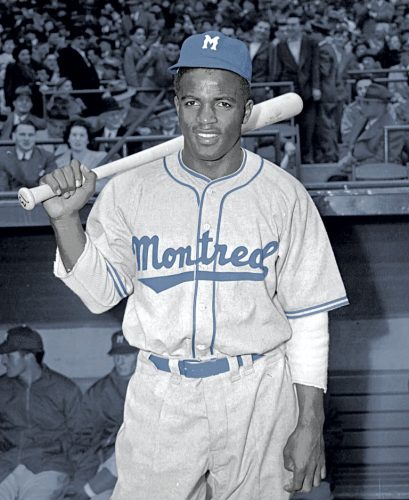
In the big leagues themselves, the regular season became a parade of statistical marvels, a definitive declaration that the power hitters and lightning arms were officially back from their wartime service.
In Cleveland, Bob Feller pitched with a fury that felt almost frightening. Returned from the Navy, “Rapid Robert” terrorized opposing hitters, firing 36 complete games and working an astounding 371.1 innings. He set a modern-era single-season record at the time by striking out 348 batters, a number so immense it more than doubled the output of Boston’s top strikeout arm.
In Detroit, the towering Hank Greenberg reminded the country of what raw power looked like, launching a major-league-leading 44 home runs and driving in 127 runs. Over in the National League, Detroit’s southpaw counterpart Hal Newhouser matched Feller’s durability, leading the senior circuit with a microscopic 1.94 ERA and 26 victories.
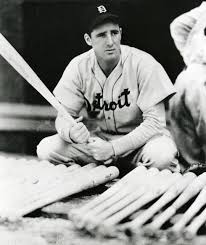
But if the American League was a coast-to-coast coronation for the 104-win Red Sox, the National League was a bruising, epic dogfight that stretched the very limits of the schedule.
The Brooklyn Dodgers and the St. Louis Cardinals went toe-to-toe through the heat of July and the damp of September, refusing to yield an inch of dirt.
For Brooklyn, it was a summer of desperate hustle, epitomized by Pete Reiser stealing home a record seven times before crashing into yet another concrete outfield wall.
For St. Louis, it was a clinic in pure baseball excellence. Stan Musial, elegant and coiled in his corkscrew stance, put together a season for the ages. “The Man” racked up an extraordinary 228 hits, including 50 doubles and 20 triples, batting a scorching .365 to capture the National League MVP. Beside him stood the fiercely competitive Enos Slaughter, who drove in a major-league-leading 130 runs, providing the heartbeat for a St. Louis club that simply refused to die.
When the scheduled 154 games concluded, the Dodgers and Cardinals stood locked in an unprecedented dead tie. For the first time in the history of the sport, a best-of-three playoff series was triggered to decide the pennant. The baseball world held its breath as the series shifted between the boroughs and the Midwest.
Ultimately, the Cardinals’ depth and pitching proved too formidable; St. Louis swept the Dodgers in two straight games, booking their ticket to meet Boston. The stage was finally set for October—a collision of two titanic empires, both heavy with stars, completely unaware of the exquisite heartbreak that was waiting at the end of the trail.
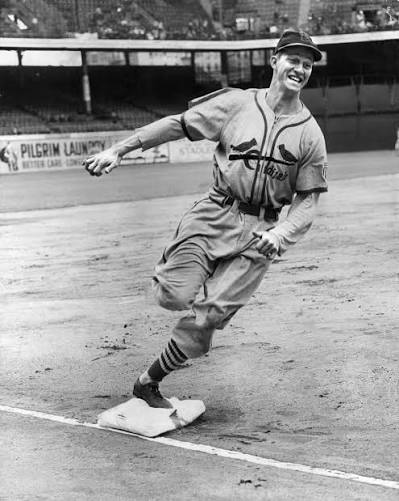
The Legend of the Red Seat & The 502 foot Moonshot
It was the second game of a late-spring doubleheader in 1946, a time when the world was trying to remember how to be young again after the smoke of war had cleared, when Ted Williams stepped into the box to look at Fred Hutchinson of Detroit.
Williams did not merely swing a baseball bat; he leveraged an entire, rigorous philosophy of hitting, sharp as a diamond cutter’s tool and unyielding as granite. When the wood met horsehide that afternoon, the sound that echoed through the small, brick-bound confines of Fenway Park was not a rattle, but a clean, sudden report that sent the ball climbing into a gray Boston sky. It kept climbing, defying the gravity that eventually claims all ballplayers, until it finally came down 502 feet away in the right-field bleachers.
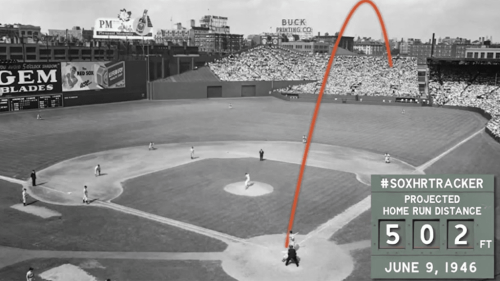
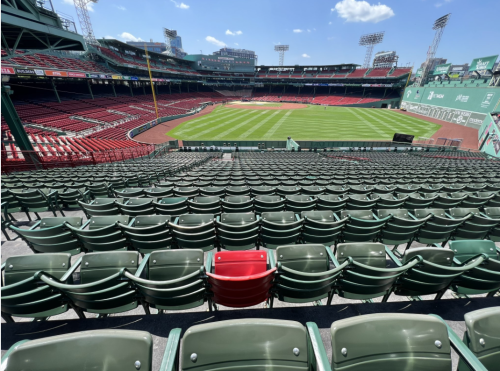
Thirty-eight years later, in 1984, the Red Sox would paint that solitary chair—Section 42, Row 37, Seat 21—a stark, lonely crimson, an island of memory floating in a green sea of summer grass.
To this day, it remains celebrated as the longest home run ever hit within those historic walls.
But baseball is a game played by men, and it always finds a way to touch them, sometimes with a literal and bruising intimacy.
There sat Joseph Boucher, a fifty-six-year-old construction engineer from Albany, New York, who had come to the ballpark looking for nothing more complicated than a pleasant Sunday afternoon away from the drawing boards.
Instead, history plummeted from the heavens and struck him squarely on the skull, punching a clean, unceremonious hole right through his straw hat.
The reporters, always looking for a romantic angle in the post-game dust, later asked him why he hadn’t fought through the scrum to secure the historic souvenir. Boucher, possessing the blunt, pragmatic dignity of a man who worked with concrete, replied that after a man takes a five-hundred-foot projectile to the cranium, his passion for collecting leather-bound keepsakes tends to evaporate.
The sun, he added dryly, had been directly in his eyes, preventing him from defending himself against the Splendid Splinter’s incoming missile.
Now, the modern game has given us radar, satellites, and the cold calculations of Statcast to reduce our wonders to columns of binary digits, and with those numbers has come a quiet, cynical disbelief.
Skeptics talk of the weather reports from June 9, noting that a fierce east wind was blowing through Fenway that afternoon. It was a wind that typically knocks down the fly balls of right-handed hitters, but on this day, it may have uniquely caught Williams’ high, soaring arc, carrying it on an invisible current beyond the natural reach of mortal men.
Even the contemporary giants, men built like fortresses compared to the lean, elegant ballplayers of the post-war era, look out at that red seat with a mixture of reverence and outright doubt.
David Ortiz, who spent a glorious career punishing baseballs into the Boston night, could never touch that distant chair. “Big Papi” spent years trying, not just in the public theater of games, but in the private hours of batting practice when a man can truly test the limits of his strength.
He reportedly went so far as to take a high-performance aluminum bat out to the plate during practice—a weapon forged for unnatural velocity—and still the ball fell short of Williams’ mark. Ortiz would ask, with the reasonable suspicion of a craftsman who knows the physical boundaries of his own immense power, why no newsreel or photograph existed to prove a ball could travel so far, despite the frantic typing of the newspaper columnists that day.
So the red seat remains, less a matter of verifiable physics and more a monument to what we wish to believe about the giants of our youth.
Whether it was the assistance of a benevolent New England breeze or the pure, unadulterated perfection of Williams’ swing, the legend survives the scrutiny of modern men who find that the past is always just slightly out of their reach.
The Strategy That Changed Baseball Forever
To understand how a single baseball mind can reshape the geometry of a diamond, one must look closely at the sticky afternoon of July 14, 1946, during a doubleheader at Fenway Park.
In the first game, Ted Williams had treated the Cleveland Indians with a terrifying, absolute cruelty, launching three home runs and driving in eight runs to single-handedly engineer an 11-10 Boston victory.
In the visiting clubhouse between games, Cleveland’s brilliant shortstop and player-manager, Lou Boudreau, stood before a blackboard, desperate, weary, and feeling the heavy weight of his own insignificance against a force of nature.
He knew he was dealing with the most disciplined pull-hitter alive, a man whose swing was an unalterable mechanical religion.
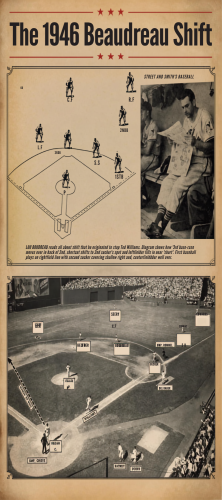
When Williams stepped to the plate in the second game, Boudreau stepped out of position and shouted a command. In an instant, the infield uncoiled into a bizarre, asymmetrical shape that looked less like baseball and more like some surrealist landscape.
Boudreau moved all four of his infielders to the right side of second base. The third baseman was stationed behind second; the shortstop stood halfway to first; the second baseman retreated into the short right-field grass.
The entire left side of the diamond was abandoned, left guarded only by left fielder George Case, who stood shallow, positioned precisely where a traditional shortstop would play. It was the birth of the “Boudreau Shift”—or more famously, the “Williams Shift”.
Williams, fiercely proud and possessing an almost spiritual devotion to his hitting mechanics, looked at the empty expanse of left field and stubbornly refused to alter his swing or push a cheap bunt.
Ty Cobb would later publicly call out “The Kid” for his lack of adaptability, but Williams remained unyielding, a man who would rather die by his own sword than live by a compromise.
Baseball historians estimate that this psychological and tactical trap would eventually shave roughly fifteen points off Williams’ lifetime batting average over his career.
Yet, in the magical summer of 1946, the shift could not derail his destiny.
Williams still finished that regular season with a magnificent .342 batting average, a major-league-leading 38 home runs, 123 RBIs, and a staggering .497 on-base percentage to claim the American League MVP.
The ultimate, poetic irony of Boudreau’s creation came on September 13, 1946, when the Red Sox hosted Cleveland with the American League pennant hanging in the balance.
In the first inning, Williams launched a towering fly ball toward left-central field. Because the Indians were deployed in the extreme shift, the left fielder was playing shallow and out of position. The ball clattered off the wall and rolled into the deep, unoccupied gaps of the outfield.
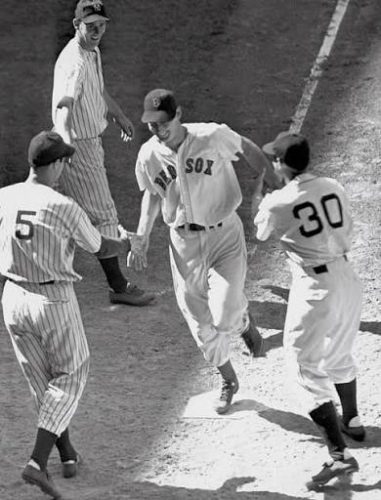
Williams, a notoriously deliberate baserunner, flew around the diamond, his long legs pumping as the crowd roared, sliding across home plate for a pennant-clinching, inside-the-park home run—the only one of his illustrious nineteen-year career.
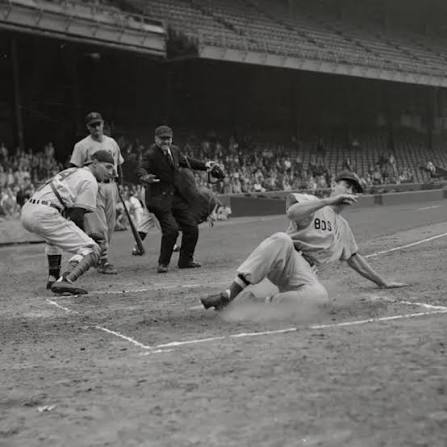
The lone run held up for a 1-0 victory.
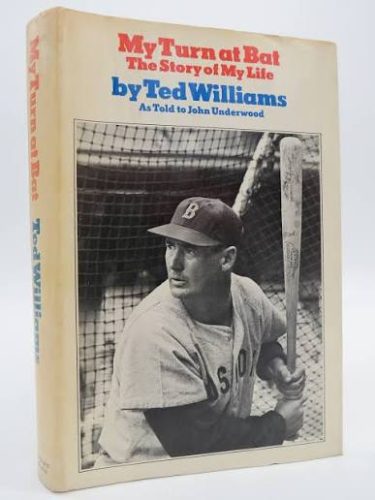
Decades later, in his evocative memoir My Turn At Bat, Williams looked back on that exhausting sprint through the dust, writing about the pure difficulty of the run: “All I know is I had to run.”
Boudreau’s mid-century gamble, born out of sheer desperation against a singular genius, accidentally laid the conceptual foundation for a completely different era of the sport. More than half a century later, in the 2010s and early 2020s, big league front offices would weaponize Boudreau’s blueprint with advanced analytics and predictive spray-chart metrics.
Extreme shifting became an algorithmic plague, smothering left-handed power hitters and deadening traditional offense across Major League Baseball.
The tactical escalation grew so severe that the game lost its natural rhythm, prompting MLB’s 11-member competition committee to finally step in during September 2022, voting to ban the extreme shift entirely ahead of the 2023 season.
It concluded an analytical epoch that traced its lineage directly back to the strategic chess match played against Ted Williams under a New England sun eighty years ago.
Seven Games on the Razor’s Edge
The World Series of 1946 was not a simple exhibition of athletic grace; it was a bruising, exhausting war of attrition played out across an unforgiving midwestern autumn.
The Red Sox, having cruised through the summer like royalty, found themselves waiting around, growing cold and rusty while the National League staged its historic tiebreaker series. To keep his boys sharp, manager Joe Cronin arranged a series of meaningless exhibition games against an American League all-star squad.
It was a decision that would haunt New England for generations.
During one of those tune-up contests, a pitch from Washington knuckleballer Mickey Haefner got away, striking Ted Williams squarely on the right elbow. The resulting swelling was immense, a dark, angry bruise that robbed “The Kid” of his terrifying, lightning-fast bat speed.
Though he stubbornly refused to ever use the injury as an excuse, the Splendid Splinter was compromised before the Fall Classic even commenced. He would struggle through a brutal 5-for-25 series with just a single RBI, a quiet, agonizing performance in what would tragically stand as the only World Series appearance of his nineteen-year career.
When the Series opened at Sportsman’s Park, the two titanic franchises immediately began trading heavy blows like heavyweight fighters in the late rounds.
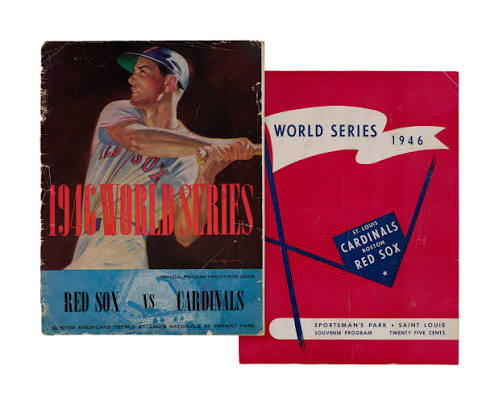
Game 1: Rudy York struck the first monumental blow for Boston, launching an extra-inning, tenth-inning home run into the St. Louis sky to steal a dramatic 3-2 opening victory.
Game 2: The Cardinals answered with a cold, clinical precision. Ace lefty Harry “The Cat” Brecheen pitched a masterful four-hit shutout, blanking the high-flying Sox 3-0.
Game 3: The series shifted back to a roaring, expectant Fenway Park. Red Sox twenty-five-game winner Dave “Boo” Ferriss threw a gem of his own, throttling the Cardinals 4-0 on a mere six hits.
Game 4: The St. Louis bats woke up with an absolute fury, exploding for twenty hits in a 12-3 blowout that silenced the Boston faithful.
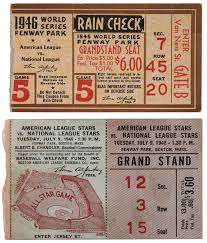
Game 5: Boston’s Joe Dobson pitched a gutty, brilliant 6-3 win to put the Red Sox on the precipice of a title, but the victory came at a terrible cost. In the middle innings, a fastball from Dobson struck Cardinals star Enos Slaughter forcefully on the right elbow.
Writhing in pain on the train ride back to Missouri, doctors informed Slaughter that his series was over. Like Williams, Slaughter possessed a fierce, old-school pride; he flatly refused to listen.
With a heavily bandaged Slaughter back in the lineup, Brecheen came back out to dominate Game 6, cruising to a 4-1 Cardinals victory. The long summer had run its course. A brutal, beautiful, exhausting baseball season came down to nine final innings on the razor’s edge.
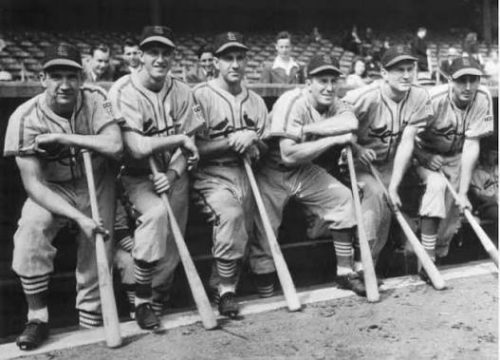
The Mad Dash and the Ghost of Johnny Pesky
By the bottom of the eighth inning of Game 7 at Sportsman’s Park, the air had grown cold, and the tension in the old ballpark was heavy enough to break a man.
The Red Sox had spent the afternoon chasing the Cardinals, finally clawing their way back from a 3-1 deficit to tie the game at 3-3 in the top of the frame.
The equalizer had come from the bat of Dom DiMaggio—a clutch, two-run double that sent New England into a frenzy.
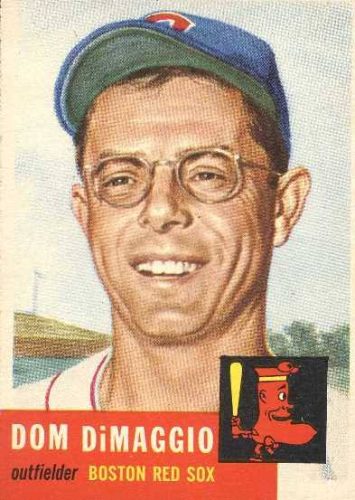
But the baseball gods, who have always favored a tragic script in Boston, demanded a price. As DiMaggio rounded second base on the play, his hamstring tore violently. He limped off the field, replaced in center by Leon Culberson, an able replacement who nevertheless lacked the majestic, instincts-driven grace of the Little Professor.
With two outs in the bottom of the eighth, the battered, broken-elbowed Enos Slaughter stepped into the box against Bob Klinger and lined a single to center. Up stepped Harry “The Hat” Walker.
With the count full, St. Louis manager Eddie Dyer pulled the strings on a hit-and-run. Slaughter, running on the pitch with a desperate, heavy-legged fury, broke for second base the moment Klinger released the ball. Walker connected, slashing a looping liner over the shortstop’s head that fell into the deep, vacant meadow of left-central field.
Culberson chased the ball down in the gap, but because Slaughter had been running with the pitch, the madcap outfielder was already rounding second base at absolute maximum speed. As he flew toward third, third-base coach Mike Gonzalez frantically threw up both hands, screaming for him to anchor down.
Slaughter completely ignored the sign. Lowering his head like a bull charging a gate, he thundered past third base toward home plate.
Culberson fired a hurried throw to shortstop Johnny Pesky, who had run out onto the outfield grass, his back turned to the plate to take the relay. Pesky caught the ball, turned, and for a microscopic, agonizing fraction of a second, hesitated.
In the deafening, wall-shaking roar of the St. Louis crowd, he simply did not realize that Slaughter was making a mad dash for the championship from first base.
By the time Pesky’s eyes found the runner and he unleashed his throw, the grace of the moment had evaporated. The throw was a tick late and sailed offline. Slaughter slid across home plate in a magnificent cloud of midwestern dust, scoring the go-ahead run.
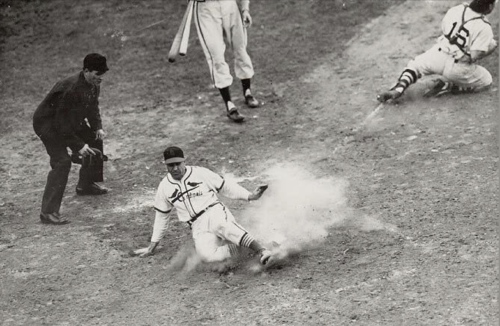
The Cardinals held on in the top of the ninth to win 4-3, capturing the World Series.
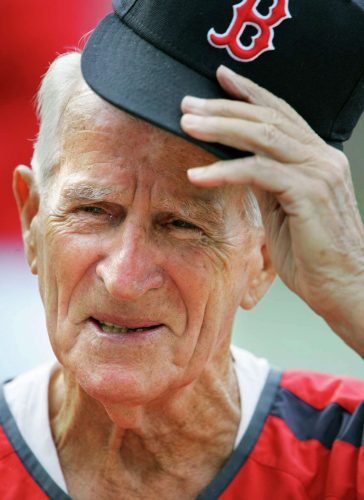
In the visitors’ clubhouse, a devastated Johnny Pesky sat quietly with his face buried in his hands, weeping for a summer that had slipped through his fingers.
Though baseball historians have spent eight decades proving that a perfect throw still wouldn’t have caught the blistering Slaughter, the narrative was permanently etched in ink.
The heartbreak belonged to Boston, and the ghost of that split-second hesitation would follow Pesky for the rest of his days.
The Giants of ’46 — A Legendary Leaderboard
To look back at the final ledger of 1946 is to look at a roll call of legends who had returned from the crucible of war to reclaim their rightful place in the American consciousness. The statistics they carved into the record books that summer read less like cold data and more like a permanent testament to an era of unvarnished brilliance.
When the dust finally settled on that first post-war campaign, these were the giants who stood atop the major league leaderboards, setting standards that would echo across the next eighty years of baseball history:
| Statistic | Player | Team | Notable 1946 Achievement / Milestone |
| Batting Average (NL) | Stan Musial | St. Louis Cardinals | Won the NL MVP while racking up an extraordinary 228 hits, 50 doubles, and 20 triples, hitting .365 to pace all of Major League Baseball. |
| Batting Average (AL) | Mickey Vernon | Washington Senators | Captured the American League batting crown by hitting a dazzling .353 in his own triumphant return from military service. |
| HR | Hank Greenberg | Detroit Tigers | Led the major leagues by launching 44 home runs and driving in 127 runs, proving the game’s premier distance hitters were officially back. |
| RBI | Enos Slaughter | St. Louis Cardinals | Carried his relentless regular-season clutch gene all the way to October, pacing the big leagues with 130 RBIs. |
| Wins | Bob Feller & Hal Newhouser | Cleveland / Detroit | Stood dead-locked atop the wins column, each claiming 26 victories as the absolute workhorses of the American League. |
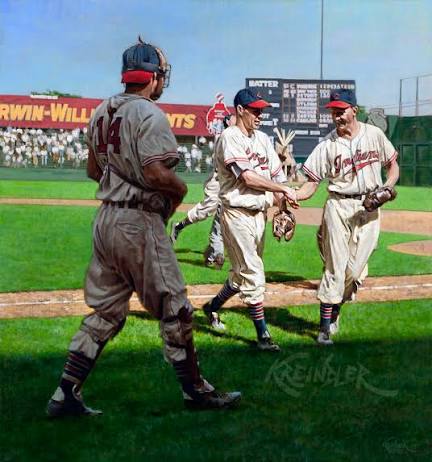
| Strikeouts | Bob Feller | Cleveland Indians | Terrorized opposing lineups to fire 36 complete games over 371.1 innings, setting a modern-era single-season record at the time with 348 strikeouts. |
| E.R.A | Hal Newhouser | Detroit Tigers | Proved why he was the era’s premier southpaw, posting a microscopic, league-leading 1.94 ERA over 292.2 masterful innings. |
The Threads That Bind New England
Eighty years removed from the dust of 1946, and forty years since the heartbreak of 1986, the emotional connective tissue between these two legendary Boston teams remains entirely unbroken. They exist in our memory not as isolated seasons, but as twin pillars of a uniquely New England folklore—squads defined by a majestic, sweeping regular-season dominance, populated by generational icons, only to be left naked to the elements when they reached the very precipice of the mountain.
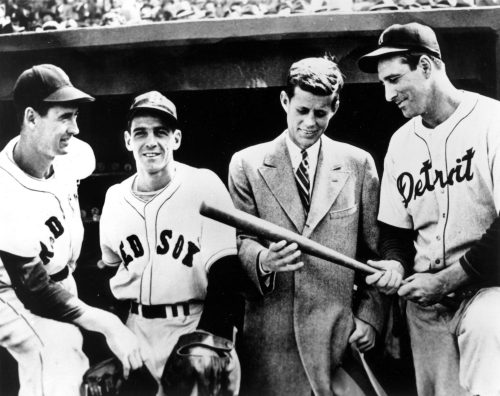
When Peter Gammons penned his spring masterpiece for BostonMan Magazine celebrating the boys of 1986, he tapped directly into this ongoing regional dialogue about the heavy cost of a baseball devotion. The parallels between these two autumns are so precise they feel less like historical coincidence and more like a recurring dream:
| Feature Dimension | The 1946 Red Sox | The 1986 Red Sox |
| Regular Season Dominance | 104–54 record; ran away with the American League pennant by May. | 95–67 record; comfortably controlled the AL East from mid-summer on. |
| Generational Star Power | Ted Williams, Bobby Doerr, Johnny Pesky, Dom DiMaggio. | Roger Clemens, Wade Boggs, Jim Rice, Dwight Evans. |
| The Shadow of Injury | Ted Williams hobbled by a deeply swollen, bruised elbow from a tune-up game. | A legendary pitching staff and key fielders quietly playing through late-season ailments. |
| Game 7 Heartbreak | Enos Slaughter’s “Mad Dash” and the agonizing hesitation on the infield grass. | A grueling, rain-delayed Game 7 loss following the late-inning collapse of Game 6. |
For decades, we treated these stories as an inheritance of curses, a solemn proof that the baseball gods harbored a personal grudge against the brick and mortar of Fenway Park. But time, mixed with the sweet relief of twenty-first-century triumphs, has a way of clearing the eyes.
We can look back at the summer of 1946 now not with the bitter sting of what was lost, but with a warm, elegiac gratitude for what they gave us.
They were the men who came home from a terrible, ash-colored global war to trade their military olive drabs for baseball flannels. They turned the stadium lights back on, filled the grandstands to numbers never before seen, and made the game feel permanent, beautiful, and whole again.
They lost the final match on a split-second delay, but they won the era, leaving behind a legacy of grace that still lingers whenever the autumn shadows grow long across the infield grass of Fenway Park.
________
Everybody Floats
_______
THE NEW ENGLAND AUTUMN arrives not with a whisper, but with a chill that creeps into the marrow of anyone who has ever spent an October shivering on the hard wooden grandstands of Fenway Park.
It is a season of long shadows, where the light dies early and the mind begins to play tricks.
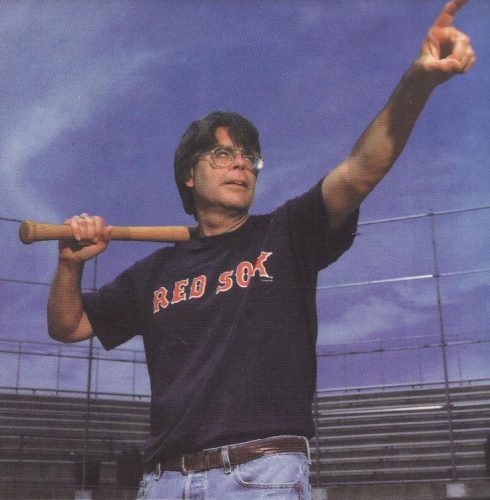
For generations of the New England faithful, baseball has never been a mere game; it has been a beautiful, agonizing religion. And no one understands the dark, gothic underbelly of that devotion quite like Stephen King, the region’s laureate of the macabre, who has spent a lifetime watching his beloved Boston Red Sox through fingers pressed against his eyes.
In King’s masterwork, IT, an ancient, shape-shifting terror emerges from the sewers of Derry, Maine, precisely every twenty-seven years to feed on the innocence and flesh of children.
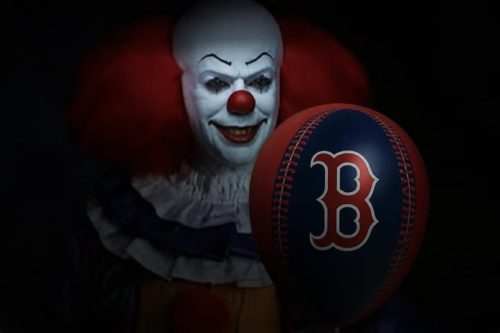
But if you talk to the old-timers in the taprooms of Biddeford or the bleacher creatures in Boston, they will tell you of a different cycle. They will tell you that the Red Sox harbor their own entity—a baseball Pennywise that sleeps, awakens, and devours the hearts of New England every forty years.
Go back a century to 1906. The Boston Americans, just three years removed from winning the first modern World Series, were supposed to be kings. Instead, the wheel turned, the gears jammed, and they plunged into a historic abyss, losing twenty consecutive games in a season that remains a monument to baseball misery.
Forty years later, in 1946, the monster wore a smile before it bared its teeth. The Red Sox were the most dominant force in the land, powered by a returning Ted Williams. But baseball gods are fickle and cruel. An irrelevant exhibition game before the World Series left Williams with a mangled elbow. Then came Game Seven against St. Louis, Johnny Pesky’s hesitation with the ball, and Enos Slaughter’s Mad Dash, scoring from first base to leave Boston bleeding on the diamond.
By 1986, forty years after Pesky wept, the cycle renewed with exquisite torment. These Sox came within a single, solitary strike of a championship in Game Six at Shea Stadium. We all know the sequence: the wild pitch, the creeping dread, and then the slow, tragic trickle of a Mookie Wilson grounder through Bill Buckner’s legs. It wasn’t just a missed play; it was a horror movie jump-scare that broke an entire generation.
Now, the calendar reads 2026.
The current campaign began like a ghost from 1906—sluggish, directionless, and seemingly doomed to the cellar. But baseball, like a King novel, thrives on false hope. In July, the Sox caught lightning in a bottle, rattling off a blistering 21-4 record and matching the 15-game winning streak of that legendary 1946 squad. They enter this postseason as the hottest team in baseball, a runaway locomotive fueled by a sudden, intoxicating magic.
The stage is set, the autumn leaves are turning crimson, and the tension in New England is thick enough to cut with a knife. The Sox appear heading back to the October dance, but the history books are wide open on the table.
Can this 2026 team finally slay the beast, reverse the forty-year cycle, and send the monster back into the deep dark? Or is Boston’s Pennywise merely waiting in the dugout, red balloon in hand, ready to remind them that down here, everybody floats?
____
Publisher’s Note, A Century of Autumns
____
The transmission of baseball between a grandfather and a grandson is a quiet, sacred business. It does not happen all at once; it passes down through the years in the low hum of a radio on a screened-in porch, the oiling of an old leather glove, and the rhythmic retelling of stories that grew grander with every passing winter.
My grandfather, Pepere, was a die-hard, lifelong repository of New England baseball devotion. He was one of those millions of young men who, in the early months of 1946, discarded his military uniform after serving our country in the crucible of World War II, looking to find an America that still resembled the home he had left behind. Like so many men of his generation, he found his anchor at the ballpark.
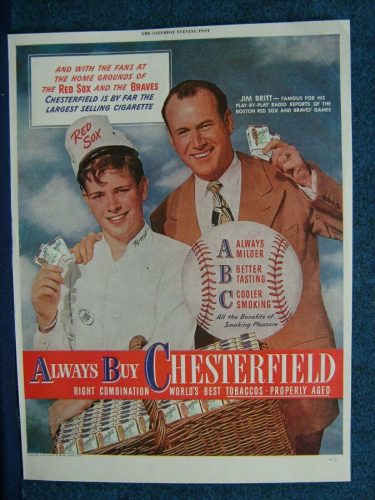
And in that magical, bittersweet summer, he sat leaning toward the speaker, tuning his radio to the warm, familiar cadences of Jim Britt and Tom Hussey for all 77 Red Sox home games—faithfully absorbing the action from suburbia Maine during an era when the team did not yet employ a radio crew to follow them on the road.
Through the static of those home broadcasts, his soul connected entirely with Ted Williams—his all-time favorite ballplayer, the Splendid Splinter, a man who commanded the sun itself over Fenway Park.
Decades later, sitting beside me, Pepere would recount, recall, and completely relive that mythical season. He told his young grandson stories of a time when the flannels were bright, the lights came back on, and the world felt permanent again.
He spoke of the joy, the absolute regular-season magic, and ultimately, the sharp, sudden heartache of that fateful October Game 7. Through those memories, I learned that baseball isn’t merely a ledger of wins and losses; it is a shared language, a beautiful bridge of love and magic that grandfathers and fathers build for their sons and grandsons.
We publish this feature story today—September 13—on the exact 80-year anniversary of Ted Williams’ iconic, defiant inside-the-park home run against Lou Boudreau’s extreme shift to clinch the 1946 American League pennant. It is an essay written in dedication to the memory of the veterans who came home to give us our game back, and to the grandfathers, among them my Pepere and Grandpa Joe, who made sure we would never forget them.
—Matt Ribaudo, Publisher
BostonMan Magazine
_______