
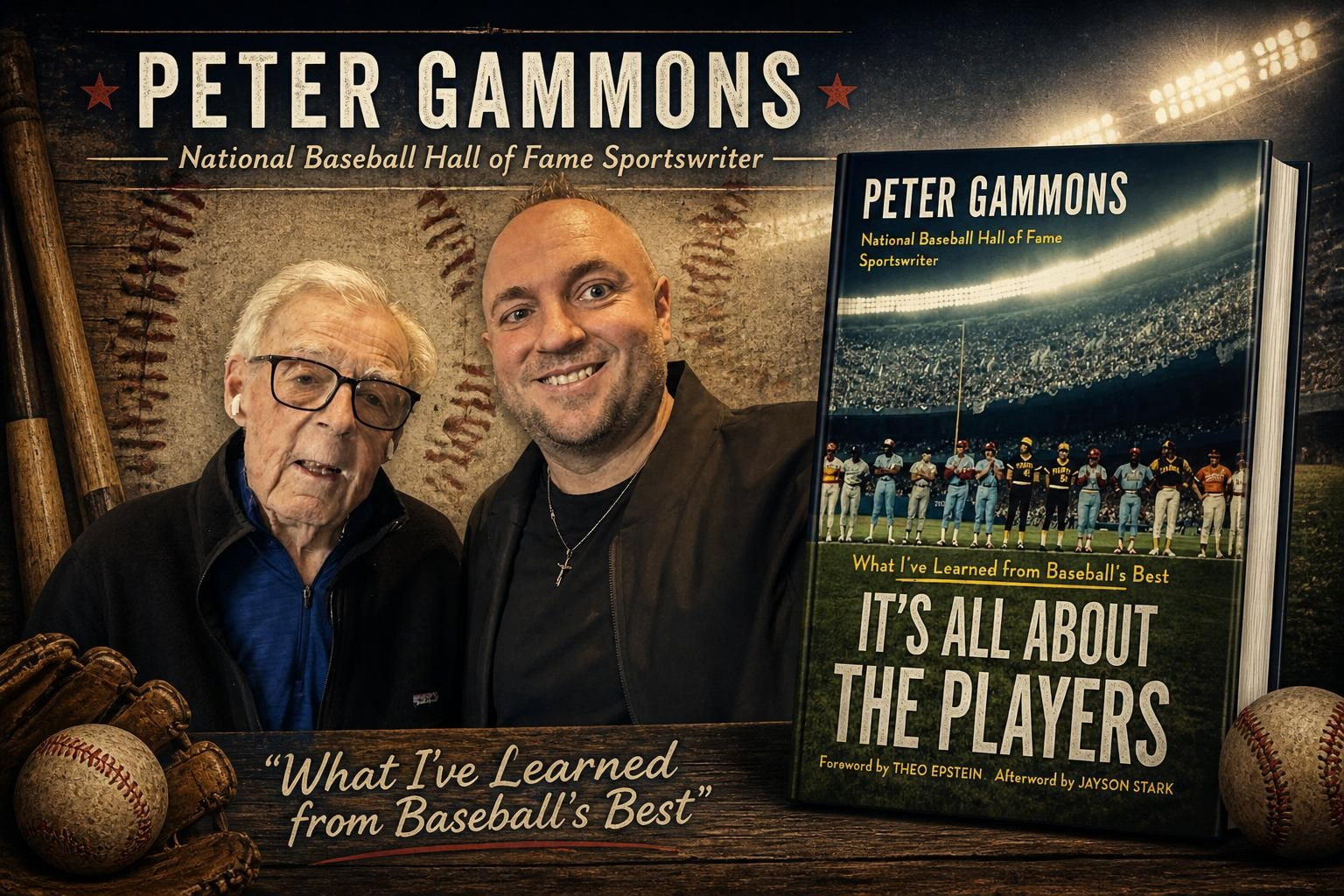

WE NEED TO TALK about what’s happened to baseball writing.
Back in the day, reading a great sports column felt like watching a prestige Sunday night HBO drama. You had this Mount Rushmore of legendary prose stylists—guys like Roger Angell, Thomas Boswell, David Halberstam, and Roger Kahn writing The Boys of Summer. They weren’t just filing copy; they were building worlds.
And right at the center of that universe was Peter Gammons. For fifty years, Gammons didn’t just cover the sport—he was the sport’s definitive narrator.
If you grew up in New England like I did, Gammons’ “Sunday Notes” column in the Boston Globe wasn’t optional reading. It was a weekly holiday. I used to sit at the kitchen table as a kid, completely devouring every single word, desperately trying to reverse-engineer his style so I could figure out how to write. He was my ultimate “far away” journalism mentor.
And look, I had a dual-mentorship setup for my childhood heroes, because right next to Gammons on my wall was Bob Ryan.
I was so obsessed with Ryan’s writing that I used to physically rewrite his columns word-for-word just to learn how to construct a paragraph. (Which, yes, makes me a total psycho, but it worked.) Fast forward a few decades, and I’m running BostonMan Magazine, with Bob Ryan actually writing cover stories on the Boston Celtics for us. Total euphoria.
Then, in the spring of 2026, I get the honor of Mr. Gammons himself penning a cover story on Roger Clemens and the ’86 Red Sox.
Getting to just sit there and listen to Peter spin stories behind the scenes? It’s the ultimate Field of Dreams scenario. You’re just completely transported.
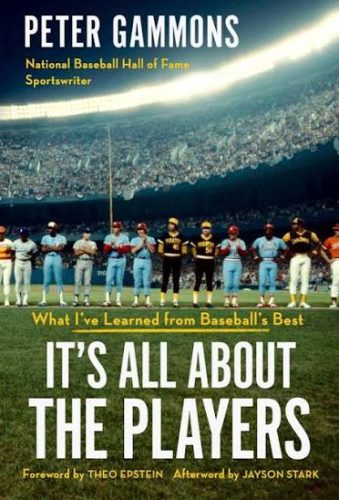
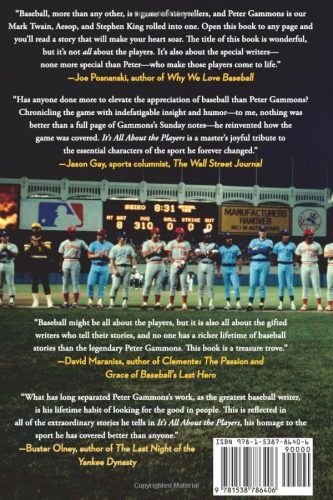
Which brings us to his awesome new book, It’s All About the Players: What I’ve Learned from Baseball’s Best.
It is vintage Gammons, and it arrives exactly when we need it most.
The 1968 Internship Story (aka, The Goosebumps Chapter)
Before we get to the modern stuff, we have to talk about my absolute favorite chapter in the book. It completely blew my mind.
We go back to June 10, 1968. Picture this: Peter Gammons and Bob Ryan are literally teenagers. They’re the only two sports interns at the Boston Globe, just trying to survive a summer trial. Weeks earlier, MLB and major media outlets all over the country had taken a massive public beating for completely missing the boat on how the sports world reacted to the MLK assassination. So when RFK is tragically assassinated in early June, the editors basically panic and tell these two teenage interns: “Go find out what every single baseball team is doing right now.”
It’s an incredible, high-stakes media sequence. They literally split the map like a draft. Bob Ryan takes the entire National League. Gammons takes the American League. They dial every single front office in the country, working furious phone lines on a brutal deadline. The next morning, these two kids don’t just get a tiny column on page 42—they land the absolute front page of the entire Boston Globe with a dual byline: “By Peter Gammons and Bob Ryan.”
Are you kidding me? If that doesn’t give you literal goosebumps as a media geek, you don’t have a pulse. It’s like watching the origin story of the Avengers, but for sports journalism.
The Battle Against the Nerds
Let’s be honest about where baseball is right now in 2026. The nerds won. The sport has been completely hijacked by a hyper-analytical, sabermetric algorithm.
We’re at a point where a giant mainframe computer basically decides every outcome before it happens. The data tells the pitcher what to throw, tells the hitter how to angle his wrists, and tells the manager exactly when to pull a guy who’s throwing a shutout because of an “efficiency metric.” It’s clinical, it’s cold, and it risks turning the game into a spreadsheet.
But baseball isn’t a math problem.
That’s why Gammons’ book feels like a necessary, counter-cultural rebellion. He’s gently pushing the laptops aside and reminding us of the human element that actually makes us care. Baseball is the ultimate generational glue.
It’s a father and son playing catch in the backyard until it’s too dark to see the ball. It’s a grandfather explaining the infield fly rule to his grandson at Fenway. It’s the unadulterated joy of kids playing on a dusty sandlot with a taped-up ball.
You don’t build an emotional attachment to an Excel sheet; you build it to the players. The connection between the fans, the writers, and the guys on the field is the actual soul of the sport.
It’s All About the Players.. and the Storytelling
The book itself bypasses the boring, chronological memoir structure and goes straight for the good stuff: a series of beautifully written, rapid-fire vignettes. Gammons empties his legendary rolodex, taking you inside the batting cages and hotel lobbies where baseball history actually happened. You get everything from the intense, stubborn genius of Ted Williams to the pure, unadulterated fun of the Big Papi era.
But where the book truly shines is when Gammons adds those deeper textures to the narrative, showing you the absolute magic behind the curtain. The chapter dissecting the complex relationship between Jim Leyland and Barry Bonds is pure theater.
Then he shifts gears to Cal Ripken Jr., perfectly capturing the profound, beautiful father-son dynamic embedded in the game—a legacy that ultimately positioned Cal to literally save baseball in ’95, earning the lifelong awe of a young Alex Rodriguez who idolized him from afar.
Gammons also tracks the incredible maturation of Theo Epstein, detailing his evolution into one of the brightest baseball minds to ever live. We see a young Theo growing up in the shadow of Fenway Park, listening to the old “Impossible Dream” record about Yaz and the ’67 Sox, and quietly envisioning himself one day fulfilling an impossible dream of his own.
And in a beautiful full-circle moment, Gammons maps his own decades-long relationship with Carl Yastrzemski, watching those deep generational roots carry all the way over to Yaz’s grandson, Mike.
All of these stories—spanning different eras, different clubhouses, and vastly different players—carry one undeniable, overarching theme: they are deeply heartwarming, profoundly magical, and told in a way that onlyPeter Gammons can tell them.
If you’re a modern fan who grew up entirely on Statcast data and launch angles, this book is the essential soul and texture you’ve been missing. If you’re a traditionalist, it’s the ultimate comfort food.
Gammons delivered a masterpiece that reminds us exactly why we fell in love with sports writing in the first place. He calls it It’s All About the Players, but he proves a different point entirely: it’s also about the legendary storytellers who keep the heart of the game beating.

It’s All About the Players: What I’ve Learned from Baseball’s Best
By Peter Gammons
Available now via major booksellers.