


The Purpose Behind the Power
By Mike Fahey, April Baker & Matt Ribaudo
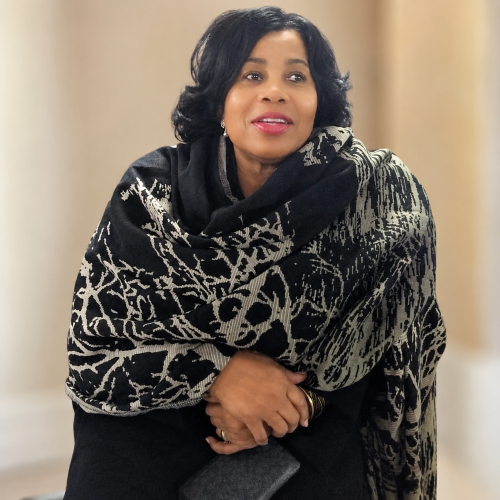
LONG before Denella J. Clark learned how to close a multimillion-dollar gift, work across Boston’s civic and nonprofit communities or lead one of Boston’s most prominent nonprofit foundations dedicated to advancing arts education, she had another career in mind entirely.
Fashion.
Clark graduated from high school at just 16 and headed to New York to study at the Fashion Institute of Technology, convinced that the creative world would become her professional home. When she returned to Boston, she took a job at Jordan Marsh, the legendary department store that once stood at the center of the city’s retail universe. She still loved clothes. She loved style. She loved the confidence that could come from knowing exactly how you wanted to present yourself to the world.
She just realized she did not want to make a career of it.
It was an early course correction in a life that would eventually become defined by something far larger than any single job title. Because if fashion taught Clark anything, it may have been the importance of presentation, possibility and imagination.
Her eventual career would require all three, only the product would change. Instead of selling clothing, she would spend decades helping people and institutions invest in ideas, opportunity and human potential.
In 1988, Clark took a job at Boston Children’s Hospital. It changed the trajectory of her life.
“For the first time, I was exposed to the world of nonprofits and the true meaning of mission and giving back,” she later recalled in an interview about her career.
There was something in that world that felt different. Purpose was not a corporate slogan attached to the work. It was the work.
Clark went on to build a career spanning some of Greater Boston’s most recognized institutions, moving through academic medicine, healthcare, human services, youth development and eventually education and the arts.

During the era when Massachusetts General Hospital and Brigham and Women’s Hospital came together under Partners HealthCare, she led employee-recognition programming and discovered an instinct for what she has memorably called “parties with a purpose.”
The phrase sounds playful. It also says a great deal about how Clark thinks.
A room full of people is an opportunity. A celebration can become a constituency. A relationship can become a partnership. And a compelling enough reason to gather people can ultimately become something that changes lives.
Over more than three decades, Clark developed a reputation for turning that instinct into results. She was part of the leadership team behind a $100 million capital campaign at Joslin Diabetes Center.
At the Dimock Center, the historic Roxbury institution providing health and human services to some of Boston’s most vulnerable residents, she led its first $25 million capital campaign. Across her career, she has secured gifts reaching eight, seven and six figures.

The numbers are impressive, but they reveal only part of the skill.
Fundraising at that level is less about asking wealthy people for checks than understanding why people give in the first place. It requires trust, patience, psychology, storytelling and an almost unusual willingness to hear no and continue building the relationship anyway.
The best fundraisers learn to translate an institutional need into something personal enough that another person begins to see themselves in the solution.
Clark became very good at that translation.
“My life’s ministry and life’s work is to advance philanthropy and public good,” she has said.
The word “ministry” is revealing. Clark does not speak about philanthropy merely as an occupation. She speaks about it as a responsibility.
That sense of responsibility also pushed her beyond the fundraising world and into public policy.
In 2015, Massachusetts Governor Charlie Baker appointed Clark to the Massachusetts Commission on the Status of Women, the independent state body charged with studying and advocating around issues affecting women and girls.
She would go on to serve in leadership and was elected chair in 2020, becoming the first Black woman to lead the Commission in its history.

The appointment gave Clark another opportunity to contribute to public service and advocate for women and girls.
“The biggest thing I have learned is that there are still opportunities to advocate for change,” she said while reflecting on the role. “I see a space where I can advocate for change and for policies that protect and advance opportunity.”
Her work with the Commission placed her in conversations about pay equity, workplace protections, economic opportunity and issues affecting women and girls. Clark has said one of her goals as chair was to amplify legislation that could directly improve the lives of those women.
It was another version of the same work she had been doing in philanthropy: locate the gap between talent and opportunity and then figure out how to narrow it.
Over the years, Boston increasingly came to know Clark not simply as a fundraiser but as a civic connector. She has participated in civic initiatives and nonprofit organizations focused on education, civil rights and community life, including work connected to former Mayor Martin J. Walsh’s administration and Mayor Kim Janey’s transition effort.

She has also served in nonprofit leadership roles focused on education and the advancement of young women.
Her accomplishments have brought their own recognition. The Massachusetts chapter of the Association of Fundraising Professionals recognized her with the Massachusetts Gives Award in the Outstanding Fundraising Professional category.
Boston Magazine has included her among the city’s most influential people, and she has been recognized among influential women of color in Massachusetts and by organizations celebrating women in leadership, philanthropy and community service.
Yet the résumé, impressive as it is, can obscure the personality underneath it.
Clark is an avid reader, a traveler, a follower of civic and public affairs and, despite abandoning that first professional ambition decades ago, still very much a lover of fashion. She has also made clear that among the many titles accumulated during a long career, the one she values most has nothing to do with a boardroom or a campaign.
“Mommy-in-Chief”
She is the mother of two adult children, and that small piece of self-description helps explain a larger pattern in her public life. Clark’s leadership has rarely been about abstraction. She tends to speak about opportunity in personal terms: the student who deserves a chance, the woman whose voice is missing from the room, the person whose talent has been overlooked because access was never equally distributed in the first place.
Her own framework for leadership has been described through four C’s: communication, critical thinking, collaboration and community.
Community may be the most important one.
Clark was born in Jamaica and grew up in Boston after her family immigrated to the United States. She came of age in a city wrestling openly and often painfully with race, class and who was entitled to opportunity.
She would eventually build her professional life inside some of Boston’s most established institutions, but her career has repeatedly brought her back to people and communities for whom entry into those institutions was anything but automatic.
That history helps explain the philosophy that has come to define her work.
Talent, Clark believes, is not scarce.
Opportunity is.
And by 2017, after nearly three decades spent learning how nonprofit institutions work, how major campaigns are built, how donors make decisions and how public policy can either expand opportunity or restrict it, Clark arrived at the role that would bring nearly every piece of her career together.
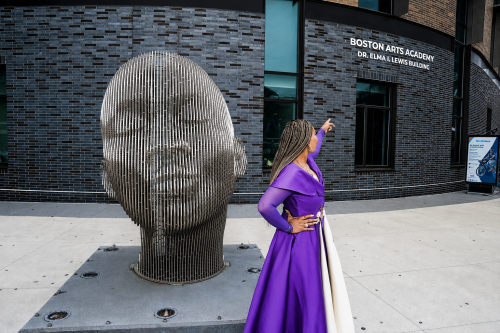
She became president and CEO of the Boston Arts Academy Foundation, an independent nonprofit foundation that secures private philanthropic resources to support Boston Arts Academy and its students.
The role brought together virtually everything that had shaped her professional life: young people, equity, philanthropy, education, civic leadership and the belief that talent should never be wasted simply because opportunity arrived unevenly.
It also gave her something else.
A canvas large enough for all of it.
Under Clark’s leadership, the Boston Arts Academy Foundation has raised tens of millions of dollars and brought prominent philanthropic and civic leaders into the work of supporting a public school whose students possess extraordinary creative ability.
The Foundation’s Building Our Future comprehensive campaign raised $36 million against a $35 million goal.
Nearly a decade into her leadership at BAAF, Clark remains focused on the long-term sustainability of the Foundation and Boston Arts Academy.
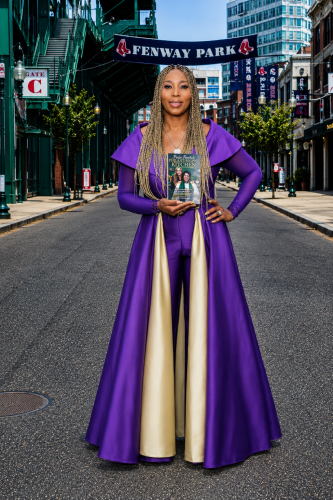
And this fall, inside a music hall beside Fenway Park, Denella Clark will once again attempt to do what she has been doing since long before Boston began putting her name on lists of its most influential people:
Gather a room.
Give it a purpose.
And invite the people inside to invest in someone else’s opportunity.
An Eye for the Arts: Boston Businesswoman, Philanthropist Hopes to Raise Record Dollars for Arts Academy This Fall
By April Baker
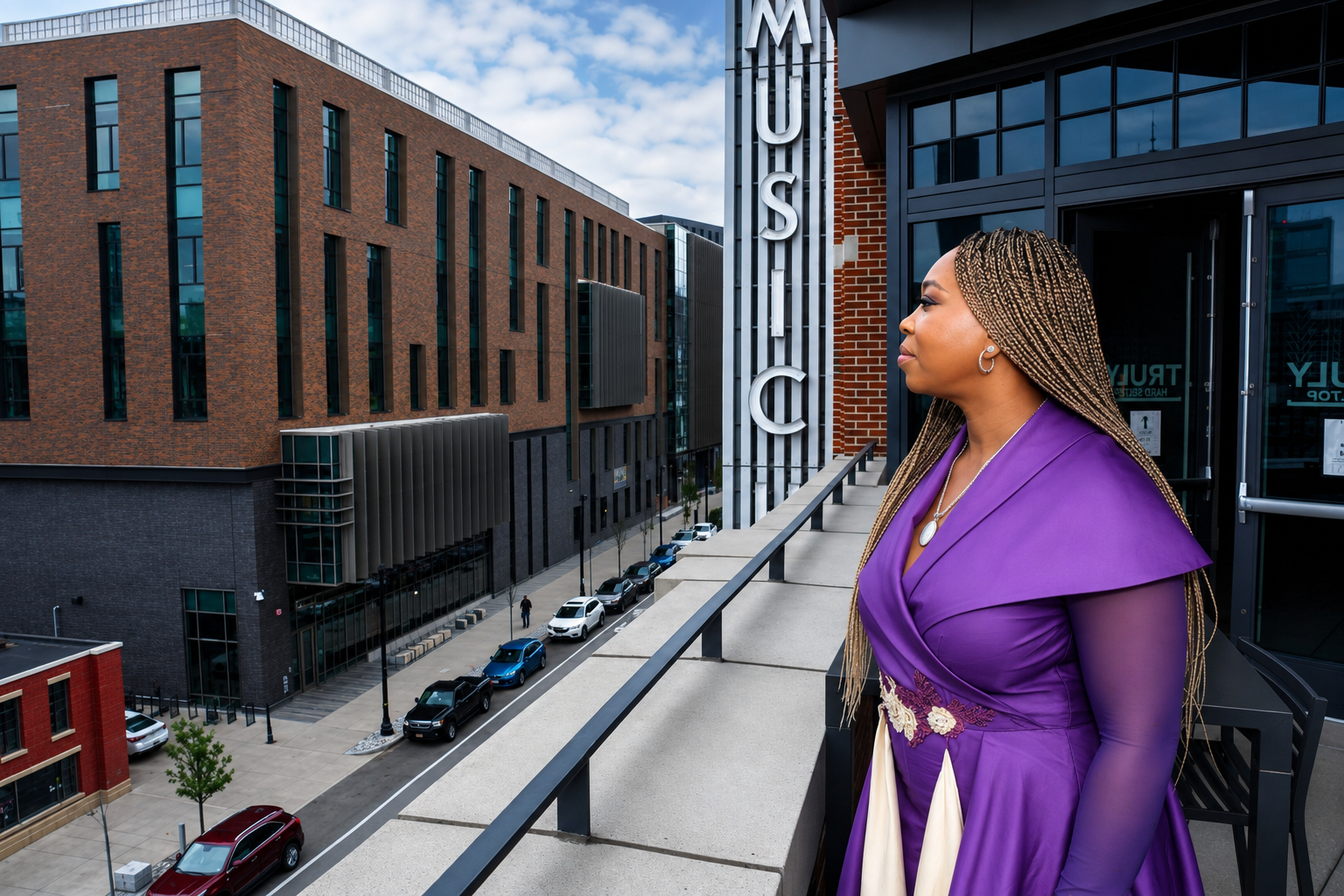
AS home game energy hums from Fenway Park, BostonMan Magazine catches up with Boston Arts Academy Foundation President and CEO Denella J. Clark next door at the MGM Music Hall, where the nonprofit’s signature fundraiser will be held this fall.
Since 2018, Boston Arts Academy Foundation’s HONORS has annually recognized leaders in dance, music, television, film, fashion, visual arts and civic responsibility.
Among this year’s honorees is actress and vocalist Jennifer Holliday, known for her breakout role in the 1981 Broadway musical Dreamgirls.
Beyond the big-name honorees, Denella hopes HONORS will set a new fundraising record this October. The event holds special meaning for her as a signature initiative of the Foundation.
“Our goal for this year’s event is $2.5 million, and I truly believe we are on pace to do just that.”
The goal would surpass the Foundation’s previous HONORS fundraising record of $2.35 million. Despite the current fundraising environment, Clark remains optimistic about what the event can accomplish.
All money raised through HONORS supports the mission of the Boston Arts Academy Foundation and, ultimately, Boston Arts Academy and its students.
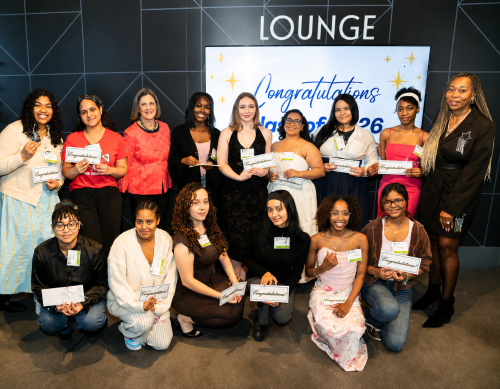
Boston Arts Academy is Boston’s only public high school dedicated to visual and performing arts education. The Foundation is an independent nonprofit organization that raises essential private philanthropic support to help bridge the gap between public funding and the true cost of an arts-intensive education.
The Foundation’s Building Our Future comprehensive campaign was completed on June 30, 2025, after a multi-year effort that raised $36 million against its $35 million goal, exceeding the goal by $1 million.
“I often say, I’m a student first. It’s what drives me, what motivates me every day,” Clark explains. “I also say that I love what I do because I love who I do it for—and that is the students and alumni of Boston Arts Academy.”
Boston Arts Academy serves approximately 500 students in grades 9 through 12. Students pursue intensive training in the visual and performing arts alongside their academic education.
Clark says fundraising for the arts school can be challenging because many organizations and programs are competing for philanthropic dollars.
She asks individuals and companies to remember the importance of investing in arts education:
“I just can’t imagine a world where we can’t walk down the street and see public art. We can’t go to the museum. So that’s how I convince people… close your eyes. What would a world be like with no artists?”
HONORS is just one of the many initiatives tied to Clark’s body of work with the Boston Arts Academy Foundation.
Wherever she finds a need, she responds.
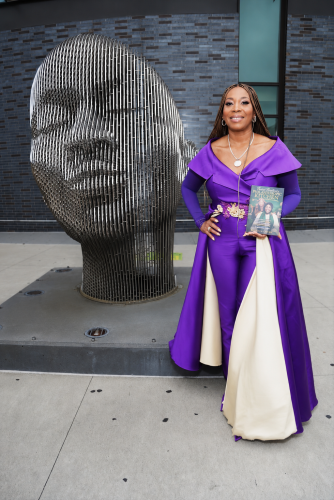
Notably, Denella launched the Alumni Lifeline Fund, which provides emergency financial aid to BAA alumni facing unexpected life crises.
She also established the Pastor Pearline James LOVIN’ Gestures Memorial Fund to lend a financial hand to those caring for loved ones.
The fund is named after her late mother, Reverend Pearline B. James.
Denella recalls her mother being the ultimate caregiver in life, working in the Mattapan community for decades, while running a daycare from their home and serving through her church and community.
“After church, my mother would gather people in her kitchen at the kitchen table. She would hear what the problem was. If we needed to raise money, if we needed to sell dinners, whatever it was that needed accomplishing, she would do it.”
To make sure her mother’s legacy isn’t forgotten, Denella strives to honor her more every year.
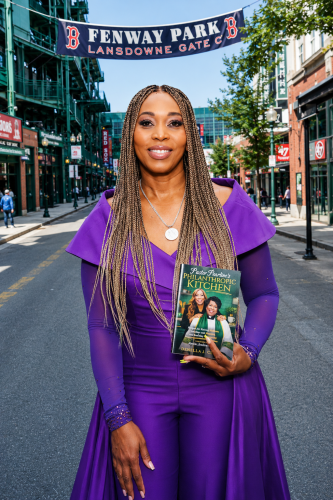
In March, she published Pastor Pearline’s Philanthropic Kitchen to honor their mother-daughter bond while highlighting the path that Pearline carved out for Denella’s community leadership and service.
In June 2025, the City of Boston honored Denella’s late mother, Pastor Pearline B. James, with a tribute marking June 26 as Pastor Pearline B. James Day. The City also dedicated Malta Street in Mattapan as Pastor Pearline B. James Way, unveiling a commemorative street sign at the corner of Malta Street and Edgewater Drive during a community celebration attended by Mayor Michelle Wu, family members and community leaders.
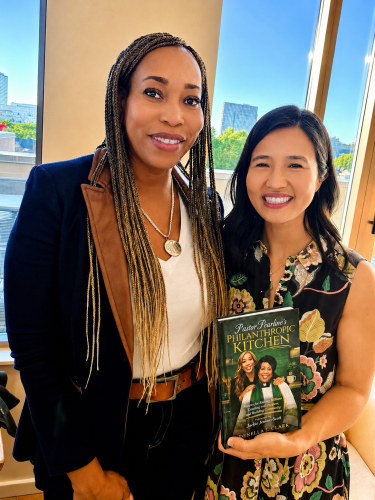
“My mother is one of the Jamaican women whose legacy is now permanently recognized through a Boston street named in her honor,” Denella remarks.
Her family immigrated from Jamaica to Boston in the 1970s, arriving in different stages.
As a child, Denella recalls difficult experiences during Boston’s school desegregation era.
She has spoken publicly about experiencing violence as a child during Boston’s school desegregation era.
While still painful, these memories don’t define Denella’s life now. They’re reminders of who she is, where she came from, and how far she has come.
But what does the future hold for her?
Denella answers, “Probably another multimillion-dollar campaign to really ensure that everything that we’ve built up at Boston Arts Academy Foundation doesn’t go away.”
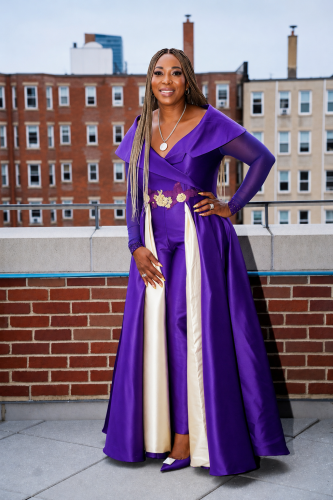
She says trust, integrity and listening to people are key ingredients to her leadership and fundraising success. Rejection can be hard, particularly when you are deeply passionate about the need and the mission you are trying to advance.
“Even on the days that I get a ‘No,’ I quietly think to myself, ‘No just means not now.’ This is hard work, and sometimes rejection can be hard. But what I have come to understand is that there is somebody out there—an individual, corporation or foundation—who understands what we are trying to accomplish and the mission we are trying to advance.”
In addition to Denella’s long-term fundraising goals, she is thinking about how to leverage Boston Arts Academy’s 30th anniversary to help raise the resources needed to support the school’s strategic priorities and long-term sustainability.
For Clark, the anniversary is not simply about celebrating 30 years; it is an opportunity to build momentum, engage the community and invest in the school’s future.
“I feel like my life’s work has been my ministry because it all started with my mom.”
As a proud grandmother, Denella is affectionately called “GLAMMY,” a fitting nickname for a grandmother who has never lost her love of fashion and personal style.
BAAF’s HONORS 2026 will take place on October 22 at MGM Music Hall at Fenway.

The Architecture of Grace: Inside Denella Clark’s Journey from a Mother’s Kitchen to the Heights of Philanthropy
By Matt Ribaudo
IF you pull up to the intersection of Malta Street and Edgewater Drive in Mattapan, you will see a city street sign that bears a name heavy with meaning: Pastor Pearline B. James Way.
To the casual passerby, it is a marker of municipal recognition. To Denella Clark, president and CEO of the Boston Arts Academy Foundation (BAAF), it is something more personal: a lasting reminder of her mother, her family’s roots in Mattapan, and the values of faith, service and community that helped shape her life and leadership.
As BAAF prepares for its HONORS 2026 celebration at MGM Music Hall at Fenway, the event will once again bring together corporate, civic and philanthropic leaders in support of Boston Arts Academy and its students.
For Clark, however, the story behind the work reaches much further back—to her mother, Pastor Pearline B. James, and to a kitchen table in Mattapan where she learned that helping people was not simply an idea. It was something you did.
Clark’s new book, Pastor Pearline’s Philanthropic Kitchen: Recipes for Raising Millions, Leading with Purpose, and Building Community, is inspired by that legacy. Part fundraising guide, part family history and part reflection on leadership, the book explores the lessons Clark learned from her mother and how those lessons continue to influence the way she leads, serves and creates opportunity.
The Lessons of a Mother’s Kitchen
Pastor Pearline James was a Jamaican immigrant, pastor, mother, caregiver and community leader who devoted much of her life to serving others.
She and her family came to Boston from Jamaica in the 1970s, eventually making their home in Mattapan. Pearline operated a daycare from her home, served in ministry and remained deeply involved in her community.
For Clark, some of her mother’s most important lessons came from watching her bring people together around the kitchen table.
“After church, my mother would gather people in her kitchen at the kitchen table. She would hear what the problem was. If we needed to raise money, if we needed to sell dinners, whatever it was that needed accomplishing, she would do it.”
Those experiences gave Clark an early understanding of philanthropy that had little to do with formal titles or large institutions. It began with people, relationships and a willingness to help.
That lesson would eventually become part of the foundation for a professional career spanning more than three decades across healthcare, human services, education, the arts, philanthropy and civic leadership.
Pearline also demonstrated that it is never too late to pursue a dream. At age 60, she graduated from Urban College of Boston, an accomplishment that was featured on the front page of The Boston Globe in 2006.
For Clark, watching her mother reach that milestone was another lesson in perseverance, determination and the power of continuing to pursue a dream at any stage of life.
A Legacy That Continues
Pastor Pearline James died in June 2023 at the age of 77. Her legacy, however, continues through the work of her daughter and the communities and institutions touched by her life.
Clark established the Pastor Pearline James LOVIN’ Gestures Memorial Fund to honor her mother’s spirit of caregiving and provide support to people caring for loved ones.
She also established the Pastor Pearline James Scholarship at Urban College of Boston, where her mother earned her degree. The scholarship honors Pearline’s own educational journey while creating opportunities for women pursuing higher education later in life.
For Clark, it is another way of ensuring that her mother’s commitment to education, service and opportunity continues to benefit others.
In 2025, the City of Boston further recognized Pearline’s community legacy by dedicating the corner of Malta Street and Edgewater Drive in Mattapan as Pastor Pearline B. James Way. Family members, community leaders and Mayor Michelle Wu gathered for the unveiling of the commemorative street sign.
For Clark, seeing her mother’s name permanently recognized in the community where she lived and served carries profound significance.
It is also a reminder of where her own story began.
Rooted in Jamaica, Raised in Mattapan
Clark was raised in Boston, but Jamaica remains central to how she understands who she is.
She is rooted in Jamaica.
The values of family, faith, community and service that shaped her early life traveled with her when her family came to Boston. They were reinforced by her experiences growing up in Mattapan and became woven into the way she approaches leadership, philanthropy and community.
Her Jamaican heritage is not simply a chapter in her biography. It is part of the foundation of who she is.
That connection is central to the story she tells in Pastor Pearline’s Philanthropic Kitchen.
The book is not simply about fundraising. It is about the values behind the work—the belief that generosity can take many forms, that communities have the power to solve problems together, and that opportunity can change the trajectory of a life.
Values Over Names
Those ideas are particularly evident in Chapter 17, “Creating a Legacy of Giving.”
At the heart of the chapter is a simple philosophy: legacy is ultimately about the values a person leaves behind and the difference those values make in the lives of others.
That philosophy also reflects how Clark talks about her own career.
She readily acknowledges that the results associated with her work have never been achieved alone. They require donors willing to invest, colleagues who do the work, partners who help bring ideas to life and communities that believe in the mission.
At the Boston Arts Academy Foundation, Clark led the organization through its Building Our Future comprehensive campaign, which raised $36 million against a $35 million goal.
The accomplishment was significant, but for Clark, the dollars are ultimately a means to an end.
The goal is opportunity.
At the Boston Arts Academy Foundation, that means supporting a public high school and its students—helping ensure that young people have access to the resources, experiences and opportunities they need to develop their talents and prepare for their futures.
That support could not happen without the individuals, corporations and foundations who believe in the mission and choose to invest in these students. Clark is grateful for every gift, large and small, and for every person and organization that helps make the work possible.
For Clark, philanthropy is an invitation for people to see what their investment can make possible.
From MGM Fenway to the Future
HONORS 2026 is one expression of that philosophy.
Co-chaired by Jill and Dean Bosco, with Lieutenant Governor Kim Driscoll serving as honorary chair, the event will bring together supporters, civic leaders and BAA students at MGM Music Hall at Fenway.
The evening will showcase the talent of Boston Arts Academy students while helping generate philanthropic support for the Foundation’s work advancing arts education.
Clark’s approach to fundraising is grounded in relationships, trust and persistence. She understands that a “no” does not necessarily mean the end of a relationship or an opportunity.
There is always another conversation, another connection and another person who may understand the mission.
But fundraising is only one part of Clark’s broader leadership. Throughout her career, she has built relationships, developed partnerships, advocated for opportunity, served in civic leadership roles and helped organizations turn vision into action.
Her work has extended beyond Boston as well, including speaking and engaging with communities and leaders in different parts of the world. Her connection to Jamaica remains important, reflecting the enduring relationship between where she was raised and where her roots began.
As she looks toward the future, Clark remains focused on sustaining and expanding the work of the Boston Arts Academy Foundation while continuing to create opportunities for young people and communities.
But the future is connected to the past.
The story began with a Jamaican mother who taught her daughter that helping people was not simply something you talked about. It was something you did.
Today, that lesson lives on in Clark’s leadership, philanthropy and community work—in Boston, in Jamaica and through the people and institutions her work has touched beyond both.
The street sign at Malta Street and Edgewater Drive carries Pastor Pearline B. James’s name. Her daughter carries forward something even less tangible, but perhaps even more lasting: the values her mother placed in her.
From Jamaica to Mattapan, and from her mother’s kitchen to the communities and institutions she now serves, the thread has remained remarkably consistent: faith, family, community, service and a belief in the power of opportunity.
For Denella Clark, that is the legacy she carries forward.

